
Understanding active and passive voice rules is an important step in learning clear and correct English. Whether you are a student, job seeker, content writer, or non-native English learner, this guide will help you confidently identify, use, and switch between active and passive voice.
This article is written in simple, clear English, with many examples, tables, and practice sentences. You do not need advanced grammar knowledge to follow along.
Sorry Generator
What Is Voice in English Grammar?
In English grammar, voice shows the relationship between the subject (doer) and the verb (action).
There are two voices in English:
- Active voice
- Passive voice
Understanding the difference helps you:
- Write clearer sentences
- Improve exam scores
- Sound more natural in English
- Avoid common grammar mistakes
What Is Active Voice? (With Simple Examples)
A sentence is in active voice when the subject performs the action.
Basic Rule of Active Voice
Subject + Verb + Object
Examples:
- She writes an email.
- The cat chased the mouse.
- They are building a house.
In each sentence:
- The subject (she, cat, they) does the action.
- The sentence is clear and direct.
Why Active Voice Is Preferred
Active voice is generally better because it is:
- Clear
- Short
- Direct
- Easy to understand
That is why:
- Teachers prefer it in exams
- Companies prefer it in emails
- Google prefers it in content
What Is Passive Voice? (With Simple Examples)
A sentence is in passive voice when the subject receives the action.
Basic Rule of Passive Voice
Object + form of “be” + past participle (+ by subject)
Examples:
- The email was written by her.
- The mouse was chased by the cat.
- A house is being built by them.
Here:
- The focus is on the action, not the doer.
- The doer may be unknown or unimportant.
Active and Passive Voice Rules (Core Grammar Rules)
Rule 1: Only Transitive Verbs Can Be Passive
A transitive verb needs an object.
✅ Can be passive:
- write (write something)
- eat (eat something)
❌ Cannot be passive:
- sleep
- arrive
- cry
Example:
- ❌ A sleep was slept (wrong)
- ✅ He slept (correct)
Rule 2: Passive Voice Uses a Form of “Be”
Passive voice always includes:
- am / is / are
- was / were
- being / been
Example:
- The work is done.
- The work was being done.
Rule 3: Past Participle Is Required
The main verb in passive voice must be in past participle form.
| Base Verb | Past Participle |
| write | written |
| eat | eaten |
| make | made |
| see | seen |
Active vs Passive Voice: Side-by-Side Comparison
| Active Voice | Passive Voice |
| She cleans the room. | The room is cleaned by her. |
| They repaired the car. | The car was repaired by them. |
| The chef cooked the meal. | The meal was cooked by the chef. |
How to Change Active Voice to Passive Voice (Step-by-Step)
Step 1: Identify Subject, Verb, Object
Active:
She (subject) writes (verb) a letter (object).
Step 2: Move the Object to Subject Position
Passive:
A letter…
Step 3: Add Correct Form of “Be”
A letter is…
Step 4: Use Past Participle
A letter is written…
Step 5: Add “by” (optional)
A letter is written by her.
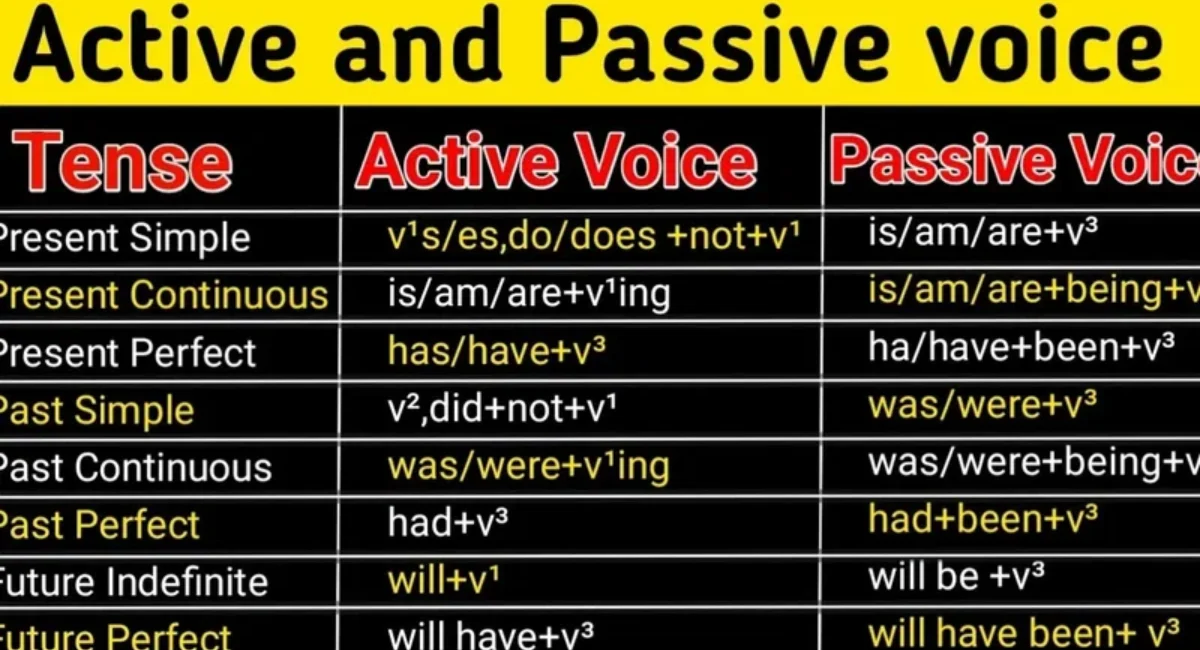
Tense-Based Active and Passive Voice Rules
Present Simple
- Active: She writes a letter.
- Passive: A letter is written by her.
Past Simple
- Active: She wrote a letter.
- Passive: A letter was written by her.
Future Simple
- Active: She will write a letter.
- Passive: A letter will be written by her.
Present Continuous
- Active: She is writing a letter.
- Passive: A letter is being written by her.
Present Perfect
- Active: She has written a letter.
- Passive: A letter has been written by her.
When Should You Use Passive Voice?
Passive voice is useful when:
- The doer is unknown
- The action is more important
- You want a formal tone
- You are writing reports or notices
Real-Life Examples:
- The road was closed due to rain.
- The documents have been submitted.
- The patient was admitted last night.
When Should You Avoid Passive Voice?
Avoid passive voice when:
- The sentence becomes long or unclear
- You want strong, direct communication
- You are telling a story or giving instructions
Weak:
The mistake was made.
Better:
We made a mistake.
Common Mistakes with Active and Passive Voice
Mistake 1: Using Wrong Verb Form
❌ The work is do.
✅ The work is done.
Mistake 2: Forgetting “Be” Verb
❌ The letter written by her.
✅ The letter was written by her.
Mistake 3: Using Passive When Active Is Better
❌ The report was completed by me.
✅ I completed the report.
Practice Sentences (Try Yourself)
Change Active to Passive:
- The teacher explains the lesson.
- They cleaned the room.
- She will announce the result.
Answers:
- The lesson is explained by the teacher.
- The room was cleaned by them.
- The result will be announced by her.
Active and Passive Voice in Exams
For School & Competitive Exams:
- Grammar questions often ask:
- Identify the voice
- Change the voice
- Correct the sentence
Tip:
Always check:
- Tense
- Be verb
- Past participle
Voice Rules for Non-Native English Learners
If English is not your first language:
- Start with active voice
- Learn common past participles
- Practice short sentences first
- Read aloud to feel the difference
FAQ: Active and Passive Voice Rules (Schema-Ready)
What is the difference between active and passive voice?
Active voice shows the subject doing the action. Passive voice shows the subject receiving the action.
Is passive voice grammatically wrong?
No. Passive voice is grammatically correct but should be used only when appropriate.
Why is active voice better than passive voice?
Active voice is clearer, shorter, and easier to understand in most situations.
Can all sentences be changed into passive voice?
No. Only sentences with transitive verbs (verbs with objects) can be passive.
How do I identify passive voice easily?
Look for a form of “be” + past participle (for example: was written, is done).
Key Takeaways: Active and Passive Voice Rules
- Active voice = subject does the action
- Passive voice = subject receives the action
- Passive voice uses be + past participle
- Active voice is usually clearer and preferred
- Passive voice is useful in formal or unknown situations
Final Thoughts & Practice Tip
Learning active and passive voice rules becomes easy with regular practice. Start by noticing voice in everyday sentences—news headlines, emails, and textbooks.
👉 Practice daily:
Rewrite 5 active sentences into passive voice (and back again).
If you want to improve your English grammar step by step, explore more topics like:
- Tenses
- Articles
- Prepositions
- Subject-verb agreement