
Adjectives in English are one of the most important parts of grammar. They help us describe people, places, things, and ideas more clearly. Without adjectives, our English sounds boring and incomplete.
In this complete guide, you will learn what adjectives are, how to use them correctly, and how to avoid common mistakes. This lesson is written in simple English, making it perfect for beginner to intermediate learners.
Sorry Generator
What Are Adjectives in English?
Adjectives in English are words that describe or give more information about a noun or pronoun.
They tell us:
- What kind?
- How many?
- Which one?
- How much?
Simple Definition
👉 An adjective describes a noun.
Examples
- A big house
- A happy child
- Three books
- A beautiful city
In each example, the adjective adds meaning to the noun.
Why Are Adjectives Important in English?
Adjectives help you:
- Speak more clearly
- Write better sentences
- Express feelings and opinions
- Sound more natural in English
Compare These Sentences
- I bought a car. ❌
- I bought a new red car. ✅
The second sentence gives more information and sounds better.
Where Do Adjectives Go in a Sentence?
In English, adjectives usually come in two main positions.
1. Adjectives Before the Noun
Most adjectives come before the noun they describe.
Structure
Adjective + Noun
Examples
- A cold day
- A smart student
- An old building
✅ This is the most common adjective position in English.
2. Adjectives After Linking Verbs
Adjectives can also come after linking verbs, such as:
be, seem, feel, look, sound, taste, smell
Structure
Verb + Adjective
Examples
- She is happy.
- The food tastes delicious.
- He looks tired.
❌ Do not use adverbs here.
✔️ Say: She is happy
❌ Not: She is happily
Types of Adjectives in English
There are many types of adjectives in English. Let’s learn the most important ones.
Descriptive Adjectives
These adjectives describe qualities or characteristics.
Examples
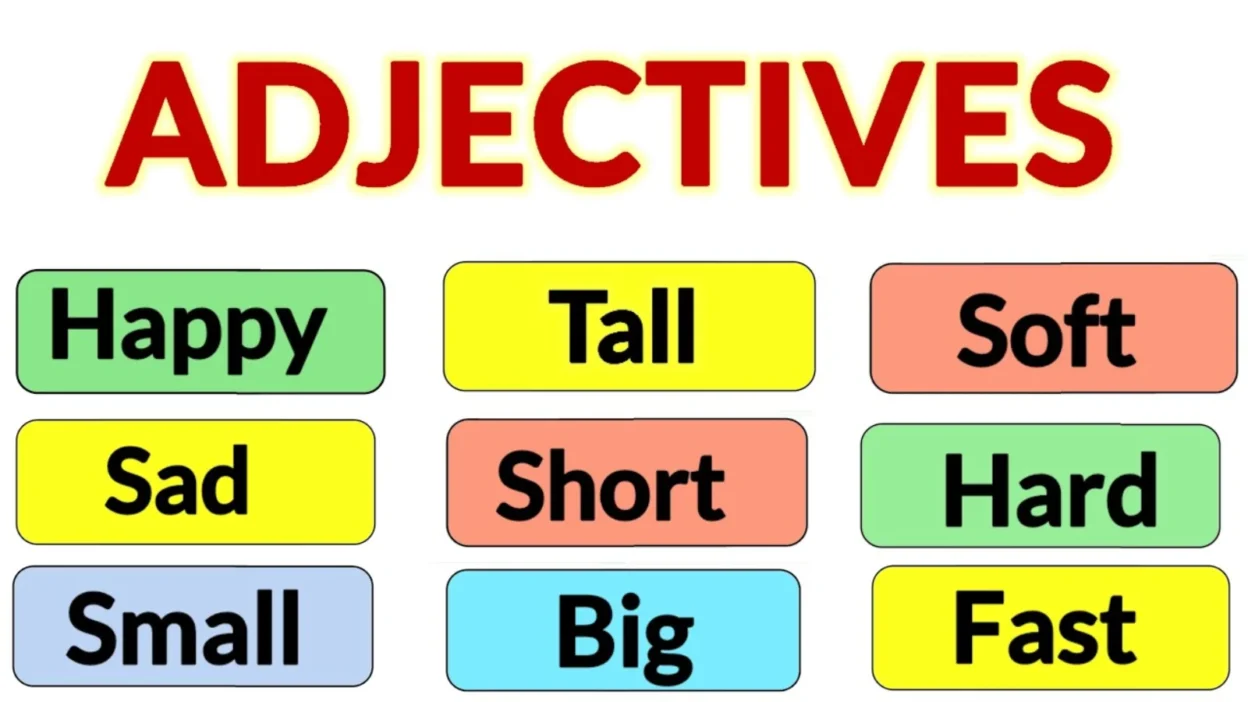
- big, small
- fast, slow
- beautiful, ugly
- smart, lazy
Sentences
- She has a beautiful smile.
- It was a long journey.
Quantitative Adjectives
These adjectives show how much or how many.
Examples
- some, many, few
- much, little
- several, enough
Sentences
- I have many friends.
- There is little water left.
Demonstrative Adjectives
These adjectives point to specific things.
| Adjective | Use |
| this | near (singular) |
| that | far (singular) |
| these | near (plural) |
| those | far (plural) |
Examples
- This book is interesting.
- Those shoes are expensive.
Possessive Adjectives
These adjectives show ownership.
| Adjective | Example |
| my | my bag |
| your | your phone |
| his | his car |
| her | her dress |
| our | our house |
| their | their school |
Sentences
- This is my pen.
- Their house is very big.
Interrogative Adjectives
These adjectives are used in questions.
Examples
- which
- what
- whose
Sentences
- Which color do you like?
- Whose bag is this?
Proper Adjectives
These adjectives come from proper nouns.
Examples
- Pakistani food
- English language
- American culture
Sentences
- I love Pakistani food.
- She teaches English grammar.
Adjective Order in English (Very Important)
When using more than one adjective, English follows a fixed order.
Common Adjective Order
Opinion → Size → Age → Shape → Color → Origin → Material → Purpose → Noun
Example
- A beautiful small old round brown Italian wooden table
This sounds natural to native speakers.
Easy Tip
👉 Opinion adjectives usually come first.
Degrees of Adjectives (Comparison)
Adjectives have three degrees.
| Degree | Example |
| Positive | tall |
| Comparative | taller |
| Superlative | tallest |
Comparative Adjectives
Used to compare two things.
Structure
- adjective + -er
- or more + adjective
Examples
- taller
- more beautiful
Sentences
- She is taller than me.
- This book is more interesting.
Superlative Adjectives
Used to compare three or more things.
Structure
- adjective + -est
- or most + adjective
Examples
- tallest
- most expensive
Sentences
- He is the smartest student.
- This is the most difficult question.
Common Mistakes with Adjectives in English
❌ Using plural adjectives
- She has blues eyes ❌
- She has blue eyes ✅
👉 Adjectives never change form.
❌ Wrong word order
- A red big car ❌
- A big red car ✅
❌ Confusing adjectives and adverbs
- She is beautifully ❌
- She is beautiful ✅
Practice Sentences (Try Yourself)
Fill in the blanks:
- She bought a ______ dress. (beautiful / beautifully)
- This is the ______ movie I have seen. (good / best)
- He has ______ friends. (many / much)
Answers:
- beautiful
- best
- many
Real-Life Examples of Adjectives
- Online shopping: cheap prices, fast delivery
- Job interviews: hardworking, confident candidate
- Daily life: hot weather, busy roads
Rewritten Version:
Adjectives are everywhere in real English.
In everyday communication, these descriptive words help give more detail about nouns and pronouns.
In English grammar, adjectives describe qualities, sizes, colors, and other characteristics of people or things.
If you want a more SEO-friendly version, try this:
SEO Version:
Adjectives are everywhere in real English.
These important descriptive words add detail and meaning to nouns and pronouns.
In English grammar, adjectives help describe qualities, sizes, colors, and characteristics clearly. They tell us more about quality, quantity, size, color, or feeling.
Frequently Asked Questions (FAQ)
What are adjectives in English?
Adjectives are words that describe nouns or pronouns and give more information about them.
Can adjectives come after nouns?
Usually no, but they can come after linking verbs like be, seem, look.
Do adjectives change with plural nouns?
No. Adjectives always stay the same.
How many adjectives can be used together?
You can use several adjectives, but you must follow the correct adjective order.
What is the most common mistake with adjectives?
Using the wrong word order and confusing adjectives with adverbs.
Quick Summary: Key Takeaways
- Adjectives describe nouns
- They usually come before nouns
- They never change form
- Adjective order is important
- Comparatives and superlatives show comparison
Final Thoughts
Learning adjectives in English will greatly improve your speaking and writing skills. Start by using simple adjectives, then slowly add comparisons and longer descriptions.