
Learning English is exciting—but grammar mistakes can slow you down or make you feel unsure. The good news? Most common English grammar mistakes are easy to fix once you understand them.
This guide is written for beginner to intermediate English learners, especially non-native speakers. We use simple English, short explanations, and real-life examples you can use right away.
By the end of this article, you will:
- Understand the most common English grammar mistakes
- Know why they happen
- Learn how to fix them
- Feel more confident when speaking and writing English 😊
Sorry Generator
Secondary Keywords Used
- English grammar rules
- Common grammar errors
- English mistakes for learners
- Grammar mistakes in English
- Learn English grammar
Why Do English Learners Make Grammar Mistakes?
Making mistakes is normal. Even native speakers make grammar mistakes every day.
Common reasons include:
- English rules are different from your first language
- Some rules have exceptions
- Spoken English and written English are not always the same
- Learning from memorization instead of real examples
👉 Mistakes mean you are learning. Let’s fix the most common ones together.
Common English Grammar Mistakes (Most Frequent Ones)
1. Subject–Verb Agreement Errors
The mistake:
Using the wrong verb form with the subject.
❌ She go to school every day.
✅ She goes to school every day.
Simple Rule
- Singular subject → verb + s
- Plural subject → base verb
| Subject | Correct Verb |
| I / You / We / They | go |
| He / She / It | goes |
Common learner mistake:
❌ My brother work here.
✅ My brother works here.
2. Confusing “a,” “an,” and “the”
Articles are one of the most common English grammar mistakes.
A vs An
- a → before consonant sounds
- an → before vowel sounds (a, e, i, o, u)
❌ an car
✅ a car
❌ a apple
✅ an apple
The
Use the when both the speaker and listener know the thing.
❌ I saw movie yesterday.
✅ I saw a movie yesterday.
❌ I liked a movie we watched.
✅ I liked the movie we watched.
3. Incorrect Use of Prepositions (in, on, at)
Prepositions cause many grammar mistakes in English.
Common Examples
| Use | Correct Preposition |
| Time | at 5pm / on Monday / in June |
| Place | in a room / on the table / at the door |
❌ I am good in English.
✅ I am good at English.
❌ She arrived to the airport.
✅ She arrived at the airport.
📌 Tip: Prepositions often must be memorized with examples.
4. Run-on Sentences and Missing Punctuation
The mistake:
Joining many ideas without punctuation.
❌ I went home I was tired I slept early
✅ I went home. I was tired, so I slept early.
Fix It By:
- Using periods (.)
- Adding conjunctions (and, but, so)
5. Mixing Up Past Simple and Present Perfect
This is one of the most confusing English grammar rules.
Past Simple
Used for finished time:
- yesterday
- last year
- in 2020
✅ I visited London last year.
Present Perfect
Used for experience or unfinished time:
- ever
- never
- already
✅ I have visited London.
❌ I have seen her yesterday.
✅ I saw her yesterday.
6. Incorrect Plural Forms
Some plurals are irregular.
❌ two childs
✅ two children
❌ many informations
✅ much information
| Incorrect | Correct |
| furnitures | furniture |
| advices | advice |
| peoples | people |
7. Confusing “There,” “Their,” and “They’re”
These sound the same but mean different things.
- There → place
- Their → possession
- They’re → they are
❌ Their going to school.
✅ They’re going to school.
❌ That is there house.
✅ That is their house.
8. Wrong Word Order in Sentences
English word order is usually:
Subject + Verb + Object
❌ I very like English.
✅ I like English very much.
❌ She to school goes every day.
✅ She goes to school every day.
9. Using Double Negatives
In English, two negatives = incorrect.
❌ I don’t need no help.
✅ I don’t need any help.
❌ He didn’t see nothing.
✅ He didn’t see anything.
10. Confusing Adjectives and Adverbs
- Adjectives describe nouns
- Adverbs describe verbs (often end in -ly)
❌ She speaks very good.
✅ She speaks very well.
❌ He is happily today.
✅ He is happy today.
Common Grammar Mistakes: Quick Practice
Try to fix these sentences:
- She don’t like coffee.
- I have finish my work yesterday.
- He is married with her.
- They was late.
Answers:
- She doesn’t like coffee.
- I finished my work yesterday.
- He is married to her.
- They were late.
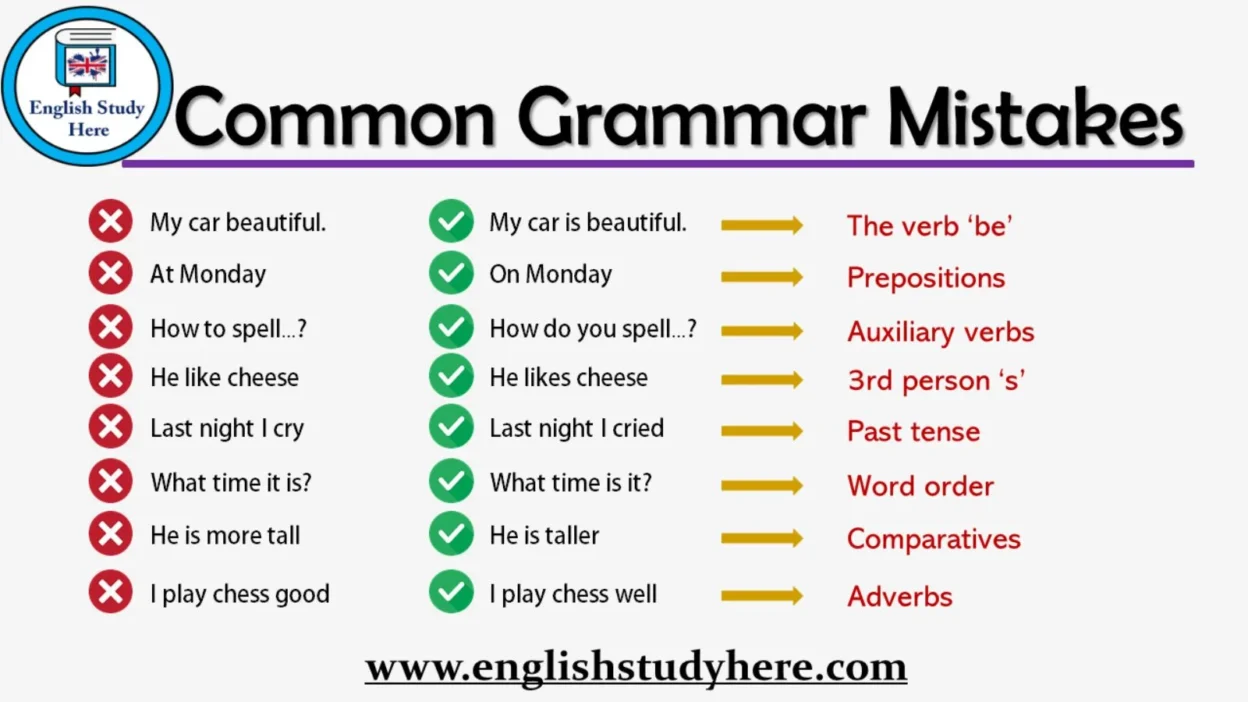
Table: Common English Grammar Mistakes at a Glance
| Mistake Type | Example (Wrong) | Example (Correct) |
| Verb agreement | She go | She goes |
| Article misuse | an book | a book |
| Prepositions | good in English | good at English |
| Tense confusion | have went | have gone |
| Word order | very like | like very much |
How to Avoid Common English Grammar Mistakes
Practical Tips That Work
- Read English every day (articles, messages, stories)
- Listen to real spoken English
- Practice short sentences
- Learn phrases, not just rules
- Review your mistakes regularly
👉 Mistakes repeated = lessons learned
Frequently Asked Questions (FAQ)
What are the most common English grammar mistakes?
The most common English grammar mistakes include verb agreement errors, article misuse, wrong prepositions, tense confusion, and incorrect word order.
Why is English grammar difficult for learners?
English grammar has many exceptions, irregular forms, and rules that differ from other languages, which makes learning harder for non-native speakers.
How can I fix grammar mistakes in English?
Practice daily, read real English content, learn from mistakes, and focus on common grammar errors instead of trying to learn everything at once.
Do native speakers make grammar mistakes?
Yes. Native speakers often make grammar mistakes, especially in spoken English. Communication matters more than perfection.
Is grammar more important than vocabulary?
Both are important, but basic grammar helps your vocabulary make sense and improves clarity.
Key Takeaways: Common English Grammar Mistakes
- Grammar mistakes are normal and fixable
- Focus on the most common English grammar mistakes
- Use examples and practice regularly
- Clarity is more important than perfection
- Confidence grows with use, not fear
Final Thoughts
Improving your English grammar is a journey—not a test. Start with the common English grammar mistakes, practice them in real life, and you’ll see progress faster than you expect.
👉 Want to improve faster? Practice daily, explore more grammar topics, and don’t be afraid to make mistakes. That’s how real learning happens. 🚀