
English grammar can feel confusing—even for people who use English every day.
If you’ve ever wondered “Is this sentence correct?”, you’re not alone.
In this guide, we’ll break down common English grammar mistakes in a simple, friendly way.
This article is designed for beginner to intermediate learners, especially non-native speakers who want to write and speak English more confidently.
You’ll find:
- Clear explanations (no grammar jargon overload)
- Real-life examples
- Common mistakes vs. correct sentences
- Practice examples you can try yourself
Let’s make English grammar less stressful and more practical. 😊
Sorry Generator
Why Do Common English Grammar Mistakes Happen?
Before fixing mistakes, it helps to understand why they happen.
Most grammar errors come from:
- Translating directly from your native language
- Learning English through conversation but not writing
- Irregular grammar rules (English has many!)
- Similar-looking words with different meanings
The good news?
👉 Most mistakes are predictable and fixable once you notice them.
Common English Grammar Mistakes You Should Avoid
Below are the most frequent grammar problems learners face in daily English.
1. Subject–Verb Agreement Errors
The Mistake
Using the wrong verb form for the subject.
Why It Happens
In English, the verb must match the subject (singular or plural). This rule is easy to forget.
❌ Common Mistakes
- She go to school every day.
- They is very friendly.
✅ Correct Sentences
- She goes to school every day.
- They are very friendly.
Quick Tip
- Singular subject → verb + -s
- Plural subject → base verb
Practice:
✔ He ___ (like / likes) coffee.
2. Confusing “Your” and “You’re”
The Mistake
Mixing up possession and contractions.
❌ Common Mistakes
- Your welcome.
- You’re phone is ringing.
✅ Correct Usage
| Word | Meaning | Example |
| Your | Shows possession | Your bag is on the table. |
| You’re | You are | You’re doing great! |
Easy Trick
If you can replace the word with “you are”, then you’re is correct.
3. Using the Wrong Verb Tense
The Mistake
Switching tenses or using the wrong one.
❌ Common Mistakes
- Yesterday, I go to the market.
- I have seen him last night.
✅ Correct Sentences
- Yesterday, I went to the market.
- I saw him last night.
Key Rule
- Past time words (yesterday, last night, in 2020) → past simple
- No specific time → present perfect
4. Confusing “There,” “Their,” and “They’re”
The Mistake
These words sound the same but mean different things.
✅ Correct Meanings
| Word | Meaning | Example |
| There | A place | The keys are over there. |
| Their | Possession | Their house is big. |
| They’re | They are | They’re happy today. |
❌ Common Mistake
- Their going to be late.
✅ They’re going to be late.
5. Missing or Misusing Articles (A, An, The)
The Mistake
Leaving out articles or using the wrong one.
❌ Common Mistakes
- I bought car yesterday.
- She is a best teacher.
✅ Correct Sentences
- I bought a car yesterday.
- She is the best teacher.
Simple Rules
- A / An → something general
- The → something specific or known
6. Run-On Sentences and Comma Splices
The Mistake
Connecting sentences without proper punctuation.
❌ Common Mistake
- I like coffee, I drink it every morning.
✅ Correct Versions
- I like coffee. I drink it every morning.
- I like coffee, and I drink it every morning.
Tip
If both parts can stand alone, use:
- A period
- A conjunction (and, but, so)
7. Incorrect Preposition Use
The Mistake
Using the wrong preposition (in, on, at, for, since).
❌ Common Mistakes
- I am married with him.
- She arrived to the airport.
✅ Correct Sentences
- I am married to him.
- She arrived at the airport.
Why This Is Hard
Prepositions don’t always follow logic. The best way to learn them is through exposure and practice.
8. Double Negatives
The Mistake
Using two negatives in one sentence.
❌ Common Mistakes
- I don’t know nothing.
- She didn’t see nobody.
✅ Correct Sentences
- I don’t know anything.
- She didn’t see anybody.
Rule
In standard English, one negative is enough.
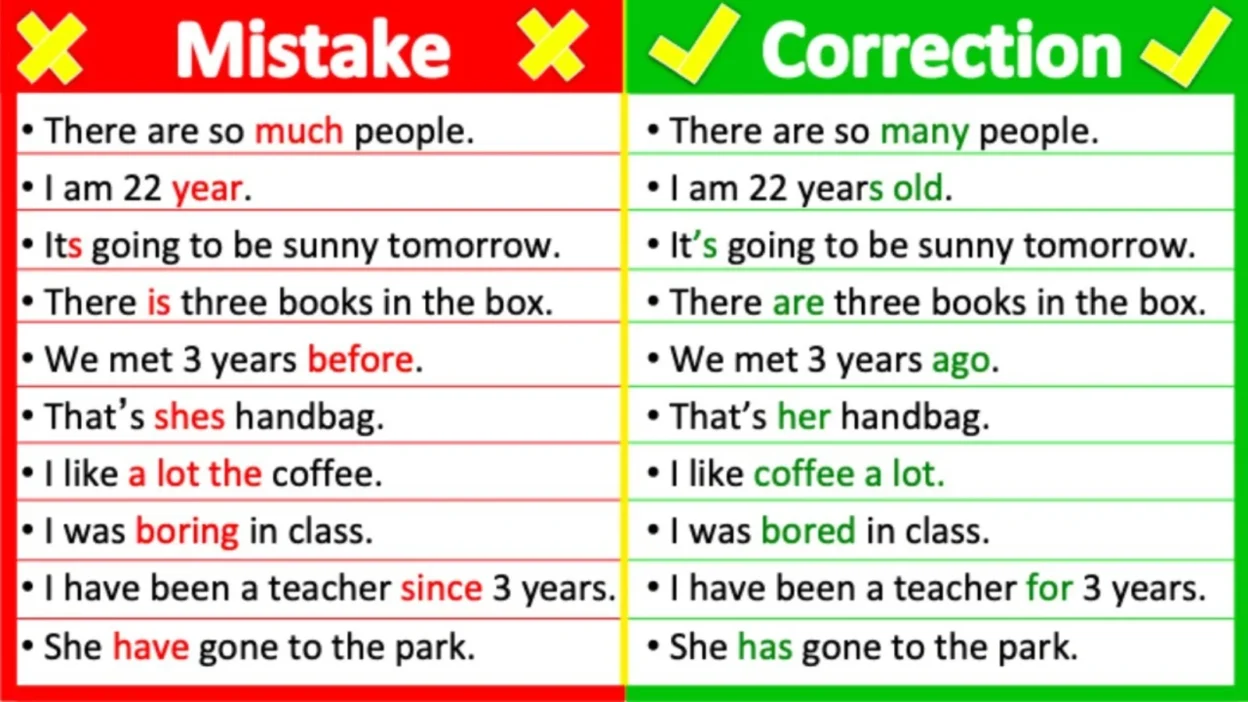
9. Confusing “Much” and “Many”
The Mistake
Using the wrong word for countable vs. uncountable nouns.
✅ Correct Usage
| Word | Used With | Example |
| Much | Uncountable nouns | much water |
| Many | Countable nouns | many books |
❌ Common Mistake
- How much people are coming?
✅ How many people are coming?
10. Capitalization Mistakes
The Mistake
Using capital letters incorrectly.
❌ Common Mistakes
- i live in canada.
- She speaks french.
✅ Correct Sentences
- I live in Canada.
- She speaks French.
Capitalize:
- “I”
- Countries and cities
- Languages
- Days and months
Common English Grammar Mistakes in Daily Conversation
Even fluent speakers make mistakes when speaking fast.
Examples:
- “He don’t know” → He doesn’t know
- “More better” → Better
- “She more taller” → She is taller
👉 Focus on clarity, not perfection. Grammar improves with time.
Practice Section (Featured Snippet Friendly)
Fix the mistakes:
- She don’t like coffee.
- I have went there yesterday.
- Their very excited about the trip.
Answers:
- She doesn’t like coffee.
- I went there yesterday.
- They’re very excited about the trip.
FAQ: Common English Grammar Mistakes
What are the most common English grammar mistakes?
The most common mistakes include subject–verb agreement, wrong verb tense, article misuse, and confusing similar words like your and you’re.
Why do non-native speakers make grammar mistakes?
Because English grammar rules often differ from their native language and include many exceptions.
How can I avoid common English grammar mistakes?
Read often, practice writing, learn from mistakes, and focus on patterns instead of memorizing rules.
Are grammar mistakes acceptable in spoken English?
Small mistakes are common and usually acceptable if the meaning is clear.
How long does it take to improve English grammar?
With regular practice, noticeable improvement can happen in a few months.
Key Takeaways: Common English Grammar Mistakes
- Grammar mistakes are normal and fixable
- Focus on patterns, not perfection
- Practice with real sentences
- Learn from errors instead of fearing them
- Clear communication matters more than perfect grammar
Final Thought (Soft CTA)
The best way to master English grammar is consistent practice.
Try writing a few sentences every day, notice your mistakes, and improve step by step.