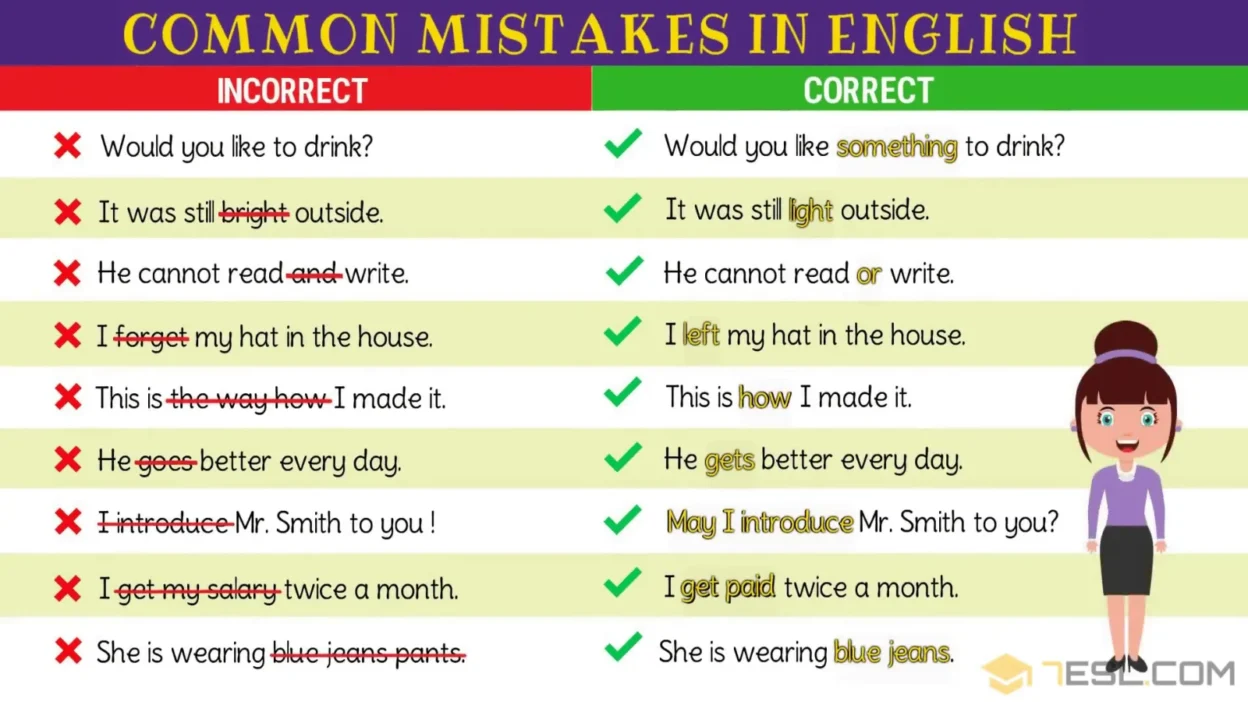
Learning English is exciting—but also confusing. Many learners make the same common English mistakes again and again, even after years of study. The good news? These mistakes are normal, and once you understand them, they are easy to fix.
This guide is written for beginner to intermediate English learners. The language is simple. The explanations are clear. Every mistake comes with real-life examples, corrections, and practice sentences so you can learn faster and feel more confident.
Let’s fix the most common English mistakes together. 🚀
Sorry Generator
Why Do Learners Make Common English Mistakes?
Before we jump into examples, it helps to know why mistakes happen.
Most common English mistakes come from:
- Translating directly from your native language
- Confusing grammar rules
- Learning English by listening, not reading
- Fear of speaking and practicing
- Similar words with different meanings
👉 Important: Making mistakes means you are learning. Even native speakers make mistakes.
Common English Mistakes in Grammar (With Easy Fixes)
1. Using He / She Incorrectly
Common mistake:
He is my sister.
Correct sentence:
She is my sister.
Why it happens:
Many languages use one word for both genders.
Quick tip:
- He → male
- She → female
Practice:
- ___ is my brother. (He / She)
- ___ is very kind. (He / She)
2. Confusing A / An / The
This is one of the most common English mistakes.
Common mistakes:
- I saw the cat (first time talking about it)
- She is a engineer
Correct sentences:
- I saw a cat.
- She is an engineer.
Simple rules:
| Article | When to use |
| A | Before consonant sounds |
| An | Before vowel sounds |
| The | When we know which one |
Practice:
- I bought ___ umbrella.
- ___ sun is very hot today.
3. Wrong Use of Plural Nouns
Common mistake:
She has two child.
Correct sentence:
She has two children.
Why it happens:
English has many irregular plurals.
Common irregular plurals:
- child → children
- man → men
- woman → women
- foot → feet
Practice:
- Two ___ are playing. (boy / boys)
- My ___ are busy. (child / children)
Common English Mistakes with Tenses
4. Mixing Past and Present Tense
Common mistake:
Yesterday, I go to school.
Correct sentence:
Yesterday, I went to school.
Rule:
If the time is in the past, the verb must be past.
Time words for past tense:
- yesterday
- last night
- last year
- ago
Practice:
- I ___ a movie last night. (watch / watched)
5. Forgetting -ed in Past Simple
Common mistake:
I finish my work.
Correct sentence:
I finished my work.
Tip:
For regular verbs, add -ed for past tense.
Examples:
- play → played
- clean → cleaned
- talk → talked
Common English Mistakes in Speaking
6. Saying Very Much Incorrectly
Common mistake:
I like English very much.
✅ This sentence is actually correct, but overused.
Better alternatives:
- I really like English.
- I enjoy learning English.
Using different expressions makes your English sound natural.
7. Confusing Say / Tell / Speak / Talk
This is a very common problem.
| Word | How to use |
| Say | Say something |
| Tell | Tell someone |
| Speak | Formal talking |
| Talk | Casual talking |
Examples:
- She said hello.
- He told me the truth.
- We talked for hours.
Common English Mistakes in Prepositions
8. Wrong Use of In / On / At
Common mistakes:
- I live on Pakistan.
- The meeting is in Monday.
Correct sentences:
- I live in Pakistan.
- The meeting is on Monday.
Simple rule:
| Preposition | Use |
| In | Countries, cities |
| On | Days, dates |
| At | Time, exact place |
9. Confusing To / For
Common mistake:
This gift is to you.
Correct sentence:
This gift is for you.
Rule:
- To → direction
- For → purpose or benefit
Common English Vocabulary Mistakes
10. Using Big for Everything
Common mistake:
I have a big problem.
Correct but not natural every time.
Better words:
- serious problem
- major problem
- huge problem
Expanding vocabulary reduces common English mistakes.
11. Confusing Make / Do
Common mistake:
I did a mistake.
Correct sentence:
I made a mistake.
Rule:
- Make → create something
- Do → action or task
Examples:
- make a decision
- do homework
Common English Sentence Structure Mistakes
12. Word Order Problems
Common mistake:
Always I wake up early.
Correct sentence:
I always wake up early.
Basic English order:
Subject + Adverb + Verb
13. Missing the Subject
Common mistake:
Is raining today.
Correct sentence:
It is raining today.
English sentences must have a subject.
Common English Mistakes in Writing
14. No Capital Letters
Common mistake:
my name is ali.
Correct sentence:
My name is Ali.
Always capitalize:
- First word of sentence
- Names
- Countries
15. Overusing Short Forms in Formal Writing
Common mistake:
I can’t attend the meeting. (formal email)
Better:
I cannot attend the meeting.
Common English Mistakes: Quick Practice Section
Fix the mistakes:
- She don’t like coffee.
- I am agree with you.
- He speak English very good.
Answers:
- She doesn’t like coffee.
- I agree with you.
- He speaks English very well.
FAQ: Common English Mistakes (People Also Ask)
What are the most common English mistakes?
The most common English mistakes include wrong verb tense, article misuse, incorrect prepositions, and sentence structure errors.
Why do non-native speakers make common English mistakes?
Because English grammar is different from many languages and learners often translate directly from their mother tongue.
How can I stop making common English mistakes?
Practice daily, read simple English, listen carefully, and review your mistakes regularly.
Are common English mistakes bad?
No. Mistakes are part of learning. Even advanced learners make them.
How long does it take to reduce common English mistakes?
With daily practice, most learners see improvement in 2–3 months.
Key Takeaways: Common English Mistakes
- Common English mistakes are normal
- Grammar and prepositions cause most problems
- Practice with examples improves confidence
- Understanding rules is better than memorizing
- Speaking daily reduces mistakes faster
Final Words (Soft CTA)
Improving English is a journey, not a race. Start by fixing one or two common English mistakes each day. Practice speaking, writing, and reading regularly.