
Conjunctions in English are small words, but they play a big role in making sentences clear, natural, and fluent. If you want to connect ideas, join words, or sound more confident in English, you must understand conjunctions.
In this complete guide, you will learn what conjunctions are, why they are important, types of conjunctions in English, and how to use them correctly. Everything is explained in simple English, with real-life examples and common mistakes that learners often make.
This lesson is ideal for beginners to intermediate learners, especially non-native English speakers.
Sorry Generator
What Are Conjunctions in English?
Conjunctions in English are words that join or connect other words, phrases, or clauses.
They help us:
- Add information
- Show contrast
- Give reasons
- Show results
- Connect ideas smoothly
Simple Definition
A conjunction is a word that connects parts of a sentence.
Example
- I like tea and coffee.
- She was tired but she continued working.
Without conjunctions, English would sound broken and unnatural.
Why Are Conjunctions Important in English?
Conjunctions are important because they:
- Make sentences longer and clearer
- Help express ideas logically
- Improve writing and speaking fluency
- Reduce repetition
- Are essential for grammar accuracy
Without conjunctions:
I woke up. I was late. I missed the bus.
With conjunctions:
I woke up late so I missed the bus.
Much better, right?
Types of Conjunctions in English
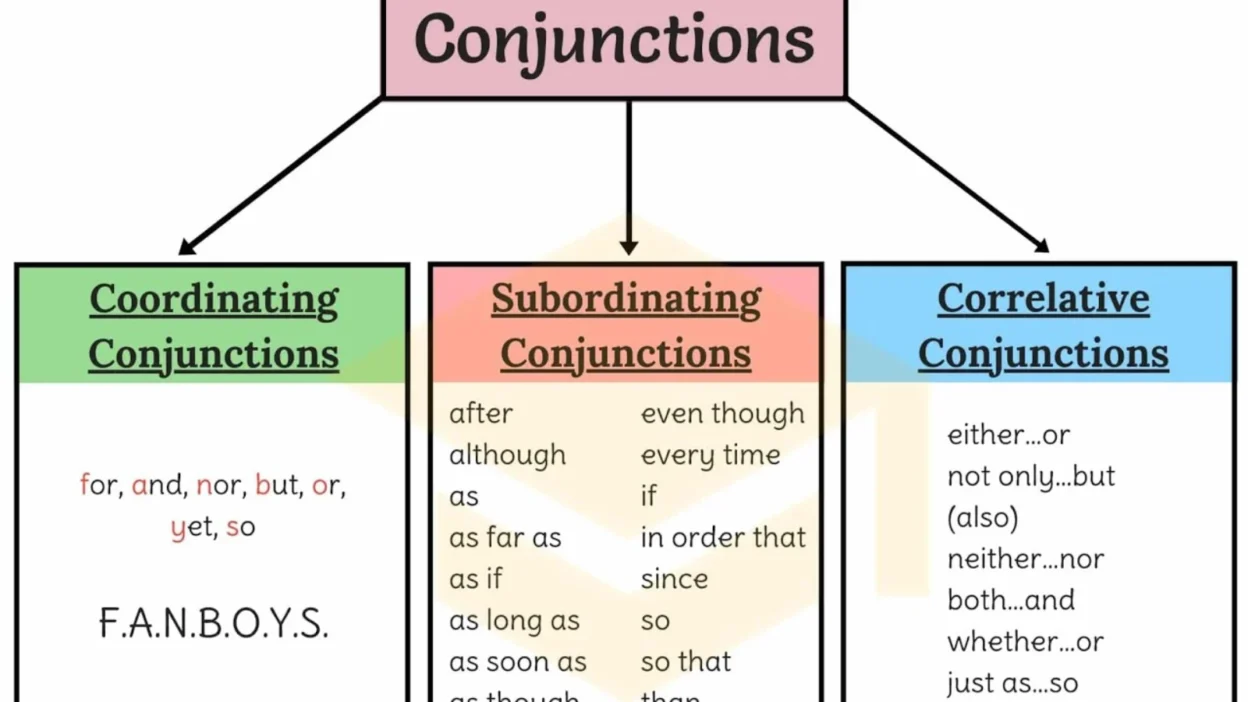
There are three main types of conjunctions in English:
- Coordinating Conjunctions
- Subordinating Conjunctions
- Correlative Conjunctions
Let’s learn them one by one.
1. Coordinating Conjunctions in English
Coordinating conjunctions connect words, phrases, or independent clauses of equal importance.
There are 7 coordinating conjunctions, often remembered by the word FANBOYS.
FANBOYS Conjunctions Table
| Conjunction | Meaning / Use |
| For | Reason |
| And | Addition |
| Nor | Negative choice |
| But | Contrast |
| Or | Choice |
| Yet | Unexpected contrast |
| So | Result |
Examples of Coordinating Conjunctions
- I was hungry and I ate dinner.
- She is poor but she is happy.
- You can call me or send a message.
- It was raining, so we stayed home.
Example Block (Featured Snippet Style)
Sentence Formula:
Clause + comma + conjunction + clause
Example:
I wanted to sleep, but I had work to do.
Common Mistakes with Coordinating Conjunctions
❌ I like tea but coffee.
✅ I like tea and coffee.
❌ She was tired so she slept. (missing comma)
✅ She was tired, so she slept.
2. Subordinating Conjunctions in English
Subordinating conjunctions connect a main clause with a dependent clause.
They explain:
- Time
- Reason
- Condition
- Contrast
Common Subordinating Conjunctions
- because
- although
- if
- when
- while
- before
- after
- unless
- since
Examples of Subordinating Conjunctions
- I stayed home because it was raining.
- Although he is young, he is very smart.
- Call me when you arrive.
- You will fail if you do not study.
Sentence Structure Tip
A subordinating conjunction can come at the beginning or middle of a sentence.
Beginning:
Because I was tired, I went to bed early.
Middle:
I went to bed early because I was tired.
Common Mistakes with Subordinating Conjunctions
❌ Because I was tired. (incomplete sentence)
✅ Because I was tired, I slept early.
❌ Although he is rich but he is unhappy.
✅ Although he is rich, he is unhappy.
3. Correlative Conjunctions in English
Correlative conjunctions work in pairs to connect equal parts of a sentence.
Common Correlative Conjunctions
- both … and
- either … or
- neither … nor
- not only … but also
- whether … or
Examples of Correlative Conjunctions
- She likes both tea and coffee.
- You can either stay or leave.
- He is not only smart but also kind.
- Neither the teacher nor the students were late.
Common Mistakes with Correlative Conjunctions
❌ Both she and her sister is coming.
✅ Both she and her sister are coming.
❌ Not only he is kind but also helpful.
✅ He is not only kind but also helpful.
Conjunctions in English: Real-Life Examples
Daily Conversation Examples
- I wanted to help, but I had no time.
- Please wait until I return.
- She stayed quiet although she was angry.
Writing Examples
- The project was difficult, yet we completed it successfully.
- You can succeed if you believe in yourself.
Practice Sentences (Try Yourself)
Fill in the blanks:
- I like apples ___ bananas.
- He stayed home ___ he was sick.
- You can ___ call me ___ email me.
- She studied hard, ___ she passed the exam.
Answers:
- and
- because
- either / or
- so
Common Conjunction Mistakes ESL Learners Make
1. Using Too Many Conjunctions
❌ Although he was tired but he worked.
✅ Although he was tired, he worked.
2. Missing Commas
❌ I was late so I ran.
✅ I was late, so I ran.
3. Sentence Fragments
❌ Because I was busy.
✅ Because I was busy, I couldn’t come.
Conjunctions vs Linking Words (Quick Clarification)
Many learners confuse conjunctions with linking words.
Conjunctions:
- Join clauses directly
- Are part of sentence grammar
Linking Words:
- Show relationships between ideas
- Often used in formal writing
Example:
- I was tired, so I slept. (conjunction)
- I was tired. Therefore, I slept. (linking word)
FAQ: Conjunctions in English (People Also Ask)
What are conjunctions in English grammar?
Conjunctions are words that connect words, phrases, or clauses in a sentence.
How many types of conjunctions are there?
There are three main types: coordinating, subordinating, and correlative conjunctions.
What is the easiest conjunction to learn?
“And” is usually the easiest conjunction because it simply adds information.
Can a sentence start with a conjunction?
Yes. Sentences can start with conjunctions like because, although, or and in informal and modern English.
What is FANBOYS in conjunctions?
FANBOYS is a memory trick for the seven coordinating conjunctions: For, And, Nor, But, Or, Yet, So.
Quick Summary: Key Takeaways
- Conjunctions connect ideas in English
- There are three main types of conjunctions
- FANBOYS helps remember coordinating conjunctions
- Subordinating conjunctions create dependent clauses
- Correlative conjunctions work in pairs
- Correct punctuation is important
Final Thoughts & Practice Tip
Mastering conjunctions in English will instantly improve your speaking, writing, and understanding of the language. Start by using one or two conjunctions daily, then slowly increase your confidence.