Learning correct English does not mean using difficult words or sounding like a textbook. It means using English clearly, naturally, and accurately so people can understand you without confusion.
This guide is written for beginner to intermediate learners, especially non-native speakers. Everything is explained in simple English, with real-life examples, practice sentences, and common mistakes.
Sorry Generator
What Is Correct English?
Correct English means using the right:
- Grammar
- Sentence structure
- Word choice
- Tense
- Punctuation
So your message is clear, polite, and natural.
✔ Correct English helps you:
- Speak confidently
- Write clearly
- Avoid misunderstandings
- Sound professional in school, work, and online
❌ Correct English does not mean:
- Using big or complex words
- Speaking like a robot
- Memorizing grammar rules without understanding
Why Correct English Is Important in Daily Life
Correct English is useful everywhere, not just in exams.
Real-life situations where correct English matters:
- Writing emails or WhatsApp messages
- Speaking in interviews
- Studying online courses
- Posting on social media
- Talking to international clients
Example:
❌ I am agree with you
✔ I agree with you
One small correction makes your English sound natural and confident.
Basic Rules of Correct English (Simple Explanation)
Let’s start with the most important rules.
1. Correct Sentence Structure
Most English sentences follow this order:
Subject + Verb + Object
Examples:
- ✔ She likes coffee.
- ✔ They are watching a movie.
Common mistakes:
❌ Likes she coffee.
❌ Watching they movie.
2. Using Correct Verb Tenses
Tenses show time: past, present, or future.
Simple Tense Examples
| Tense | Example |
| Present | I work every day. |
| Past | I worked yesterday. |
| Future | I will work tomorrow. |
Common mistake:
❌ Yesterday I go to school.
✔ Yesterday I went to school.
3. Subject-Verb Agreement
The verb must match the subject.
Rule:
- Singular subject → singular verb
- Plural subject → plural verb
Examples:
- ✔ He runs fast.
- ✔ They run fast.
Common mistakes:
❌ He run fast.
❌ They runs fast.
4. Correct Use of Articles (a, an, the)
Articles are small but very important in correct English.
When to use a / an
- For something not specific
✔ I bought a book.
✔ She ate an apple.
When to use the
- For something specific
✔ The book on the table is mine.
Common mistakes:
❌ She is teacher.
✔ She is a teacher.
5. Correct Prepositions (in, on, at)
Prepositions show time, place, and direction.
Time:
- at → exact time (at 5 pm)
- on → days (on Monday)
- in → months/years (in June, in 2026)
Place:
- in → inside (in the room)
- on → surface (on the table)
- at → point (at the door)
Common mistake:
❌ I am good in English.
✔ I am good at English.
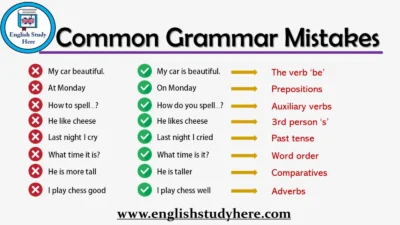
Common Grammar Mistakes and Corrections
These mistakes are very common among learners.
1. Wrong verb form
❌ He don’t like tea.
✔ He doesn’t like tea.
2. Double past tense
❌ Did you went there?
✔ Did you go there?
3. Wrong plural form
❌ She has many informations.
✔ She has a lot of information.
Correct English in Speaking vs Writing
Spoken and written English are slightly different.
Spoken English:
- Short sentences
- Natural tone
- Contractions used
✔ I’m tired.
✔ That’s okay.
Written English:
- Clear grammar
- Full forms (in formal writing)
✔ I am tired.
✔ That is acceptable.
How to Improve Correct English Naturally
You don’t need to memorize hundreds of rules.
Practical tips:
- Read simple English daily (blogs, news, stories)
- Listen to slow English videos or podcasts
- Practice writing short paragraphs
- Speak without fear of mistakes
- Learn from corrections
Daily practice example:
Write 5 sentences every day about:
- Your routine
- Your job or studies
- Your plans
Practice Sentences (Try Yourself)
Original corrected sentences:
- ✔ She doesn’t know the answer.
- ✔ I have been living here since 2020.
- ✔ He has bought a new phone.
Improved version (varied sentence structure):
- ✔ She doesn’t know the answer.
- ✔ Since 2020, I have been living here.
- ✔ Recently, he has bought a new phone.
Why this is better
- Sentences do not all start with She / I / He.
- The text sounds more natural and engaging.
- It improves readability and writing quality.
Quick Tip
When writing multiple sentences together, try starting them with:
- Time phrases: Since 2020, Recently, Yesterday…
- Transitions: However, Also, In addition…
- Prepositional phrases: In my city, At home, During the meeting…
Example:
- Since 2020, I have been living here.
- In my free time, I study English.
- Recently, he has bought a new phone.
✅ This simple trick helps avoid repetitive sentence patterns.
Correct English for Beginners (Quick Tips)
- Keep sentences short
- Use common words
- Speak slowly and clearly
- Focus on meaning, not perfection
Remember: Clear English is better than perfect English.
Featured Snippet Style Example
Question: What is correct English?
Answer:
Correct English means using proper grammar, sentence structure, and word choice so your message is clear, natural, and easy to understand.
FAQ: Correct English (People Also Ask)
What does correct English mean?
Correct English means using grammar, vocabulary, and sentence structure properly so your message is clear and natural.
Is correct English the same as fluent English?
No. You can be fluent but still make grammar mistakes. Correct English focuses on accuracy and clarity.
How can I learn correct English easily?
Practice daily, read simple English, listen to native speakers, and correct small mistakes step by step.
Can I speak correct English without perfect grammar?
Yes. Focus on basic grammar and clear sentences. Communication is more important than perfection.
Why do non-native speakers struggle with correct English?
Because English has different grammar rules, verb forms, and sentence patterns compared to other languages.
Key Takeaways: Correct English Made Simple
- Correct English is about clarity and accuracy
- Follow basic grammar rules
- Avoid common mistakes
- Practice speaking and writing daily
- Learn naturally, not by memorizing only
Final Thoughts
Learning correct English is a journey, not a race. Small improvements every day make a big difference over time.