
Direct and indirect speech is one of the most important grammar topics in English. It helps us report what someone said—in speaking, writing, exams, and real conversations.
If you are a non-native English learner, don’t worry. This guide explains direct and indirect speech in simple English, step by step, with clear examples and common mistakes.
By the end of this article, you will be able to:
- Understand the difference between direct and indirect speech
- Change sentences correctly
- Use reporting verbs with confidence
- Avoid common grammar errors
Sorry Generator
What Is Direct and Indirect Speech?
Direct and Indirect Speech are two ways to report what someone has said.
In English grammar, reported speech helps us share conversations and statements clearly.
Direct Speech (Exact Words)
Direct speech shows the exact words spoken by a person.
Quotation marks are used to present the speaker’s original words.
Example:
She said, “I am learning English.”. Quotation marks are used to show the original statement clearly.
For example:
- She said, “I am tired.”
- Ali said, “I will call you later.”
Direct speech keeps the speaker’s original words without any changes.Quotation marks are used to show the original statement clearly.
For example:
- She said, “I am tired.”
- Ali said, “I will call you later.”
Direct speech keeps the speaker’s original words without any changes.. We use quotation marks (” “).
Example:
- She said, “I am tired.”
- Ali said, “I live in Lahore.”
Indirect Speech (Reported Speech)
Indirect speech reports the message without exact words. Quotation marks are not used.
Example:
- She said that she was tired.
- Ali said that he lived in Lahore.
👉 The meaning stays the same, but the structure changes.
Key Differences Between Direct and Indirect Speech
| Direct Speech | Indirect Speech |
| Uses quotation marks | No quotation marks |
| Exact words | Meaning only |
| Present tense possible | Often tense changes |
| Informal | More formal |
Why Direct and Indirect Speech Is Important
You use direct and indirect speech when:
- Writing stories or essays
- Reporting news
- Answering grammar questions
- Speaking politely and clearly
- Writing emails or reports
This topic is very common in school exams, IELTS, CSS, PMS, and job tests.
Basic Rules of Direct and Indirect Speech
Let’s learn the rules slowly and clearly.
Rule 1: Change in Tense (Backshifting)
When the reporting verb is in the past tense, the tense of the sentence usually changes.
Tense Change Table
| Direct Speech | Indirect Speech |
| Present Simple | Past Simple |
| Present Continuous | Past Continuous |
| Present Perfect | Past Perfect |
| Past Simple | Past Perfect |
| Will | Would |
| Can | Could |
Example Sentences
Direct:
- He said, “I work hard.”
Indirect:
- He said that he worked hard.
Rule 2: Change in Pronouns
Pronouns change according to who is speaking and who is listening.
Examples
Direct:
- She said, “I am busy.”
Indirect:
- She said that she was busy.
Direct:
- He said to me, “You are late.”
Indirect:
- He told me that I was late.
Rule 3: Change in Time and Place Words
Words related to time and place often change.
Common Changes
| Direct Speech | Indirect Speech |
| now | then |
| today | that day |
| yesterday | the previous day |
| tomorrow | the next day |
| here | there |
| this | that |
Example
Direct:
- She said, “I will go tomorrow.”
Indirect:
- She said that she would go the next day.
Reporting Verbs in Indirect Speech
Reporting verbs tell us how something was said.
Common Reporting Verbs
- said
- told
- asked
- explained
- promised
- advised
- ordered
Said vs Told (Very Important)
| Said | Told |
| No object needed | Object is required |
| He said that… | He told me that… |
❌ He said me that…
✅ He told me that…
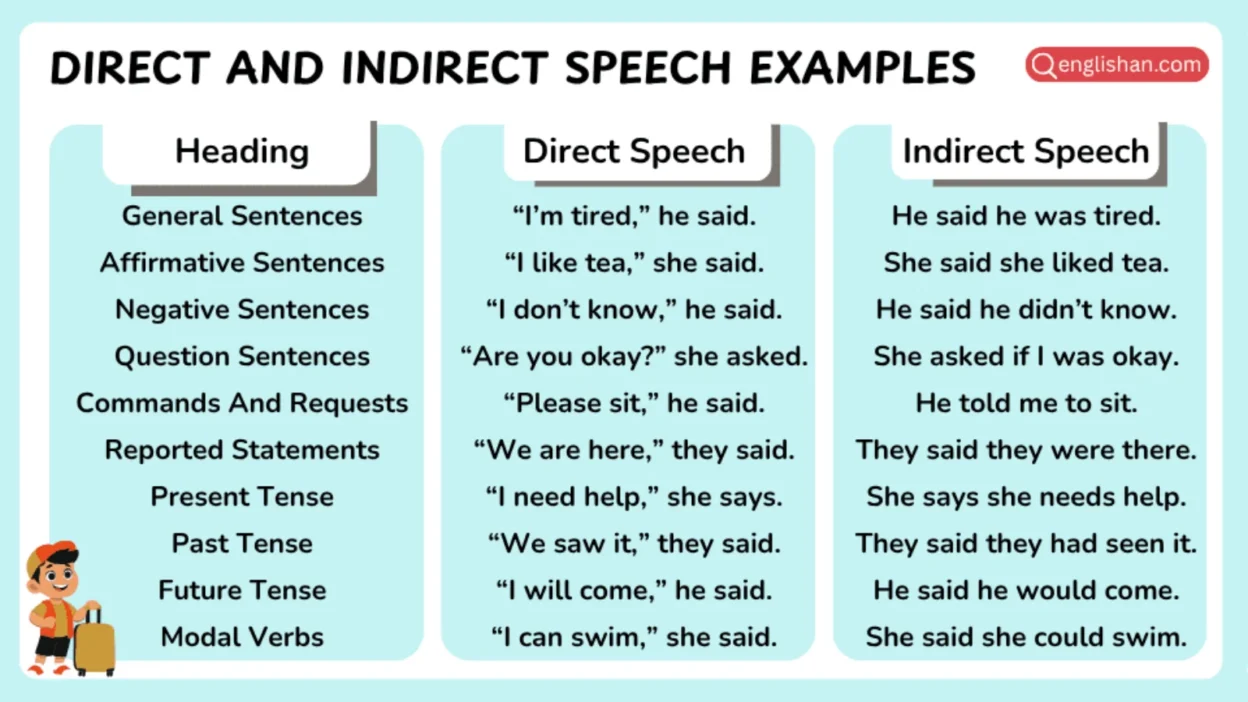
Direct and Indirect Speech of Statements
Statements are simple sentences (not questions or commands).
Example
Direct:
- She said, “I like tea.”
Indirect:
- She said that she liked tea.
👉 “that” is optional but recommended for beginners.
Direct and Indirect Speech of Questions
Questions need special care.
Important Rules
- Remove question marks
- Do not use do / does / did
- Use if / whether for yes-no questions
Yes / No Questions
Direct:
- He asked, “Are you ready?”
Indirect:
- He asked if I was ready.
Wh-Questions
Direct:
- She asked, “Where do you live?”
Indirect:
- She asked where I lived.
Direct and Indirect Speech of Commands and Requests
Commands use to + verb in indirect speech.
Examples
Direct:
- The teacher said, “Open your book.”
Indirect:
- The teacher told us to open our books.
Direct:
- He said, “Please help me.”
Indirect:
- He requested me to help him.
Direct and Indirect Speech of Advice
Advice often uses should or reporting verbs like advised.
Direct:
- She said, “You should rest.”
Indirect:
- She advised me to rest.
When Tense Does NOT Change
Tense does not change when:
- The statement is a general truth
- The reporting verb is in present tense
Examples
Direct:
- He said, “The sun rises in the east.”
Indirect:
- He said that the sun rises in the east.
Common Mistakes in Direct and Indirect Speech
❌ Mistake 1: Wrong tense change
Wrong: He said that he is tired.
Correct: He said that he was tired.
❌ Mistake 2: Using quotation marks in indirect speech
Wrong: He said that “he was late.”
Correct: He said that he was late.
❌ Mistake 3: Incorrect reporting verb
Wrong: He said me to wait.
Correct: He told me to wait.
Practice Sentences (Try Yourself)
Change these into indirect speech:
- She said, “I am learning English.”
- He said, “I will call you tomorrow.”
- They said, “We have finished our work.”
👉 Practice daily to improve faster.
Direct and Indirect Speech in Real Life
You use this grammar when:
- Telling a friend what a teacher said
- Reporting office instructions
- Writing news or summaries
- Answering exam questions
Example:
- My boss said that the meeting was canceled.
Frequently Asked Questions (FAQ)
What is direct speech in simple words?
Direct speech shows the exact words someone said, using quotation marks.
What is indirect speech also called?
Indirect speech is also called reported speech.
Is “that” necessary in indirect speech?
No, but using that makes sentences clearer for learners.
Do we always change tense in indirect speech?
No. Tense does not change for general truths or when the reporting verb is in the present.
Which tense is most common in indirect speech?
The past simple and past perfect are most common.
Quick Summary: Key Takeaways
- Direct speech = exact words
- Indirect speech = reported meaning
- Quotation marks are removed
- Tense, pronouns, and time words often change
- Practice is the key to mastery
Final Thoughts
Direct and indirect speech becomes easy when you understand the rules and practice regularly. Start with simple sentences, then move to questions and commands.