
Direct and indirect speech rules are an essential part of English grammar. They help us report what someone said, thought, or asked—either using their exact words or by paraphrasing them.
If you’ve ever wondered:
- How do I change direct speech into indirect speech?
- Why do tenses change in reported speech?
- Do questions and commands follow different rules?
You’re in the right place.
This complete guide explains direct and indirect speech rules in simple, clear English, with plenty of examples, tables, and practice sentences. It’s written especially for non-native learners, beginners, and intermediate students who want confidence—not confusion.
Sorry Generator
What Is Direct Speech?
Direct speech reports the exact words spoken by a person. We use quotation marks (“ ”) and do not change the original sentence.
Example:
- She said, “I am tired.”
- John said, “I will call you later.”
Key Features of Direct Speech
- Uses quotation marks
- Keeps original tense
- Keeps original pronouns and time words
- Often includes a reporting verb (said, asked, replied)
What Is Indirect Speech?
Indirect speech (also called reported speech) tells us what someone said without using their exact words. Quotation marks are removed, and the sentence structure often changes.
Example:
- She said that she was tired.
- John said that he would call me later.
Key Features of Indirect Speech
- No quotation marks
- Tense usually changes
- Pronouns and time expressions often change
- Uses reporting verbs (said, told, asked)
Direct vs Indirect Speech: Quick Comparison
| Feature | Direct Speech | Indirect Speech |
| Quotation marks | Yes | No |
| Exact words | Yes | No |
| Tense change | No | Usually yes |
| Pronoun change | No | Often yes |
| Example | “I am happy,” she said. | She said she was happy. |
Basic Rule: How Direct Speech Changes to Indirect Speech
To convert direct speech into indirect speech, we usually change:
- Tense
- Pronouns
- Time and place words
- Sentence structure
Let’s break these down one by one.
1. Tense Change Rules (Most Important Part)
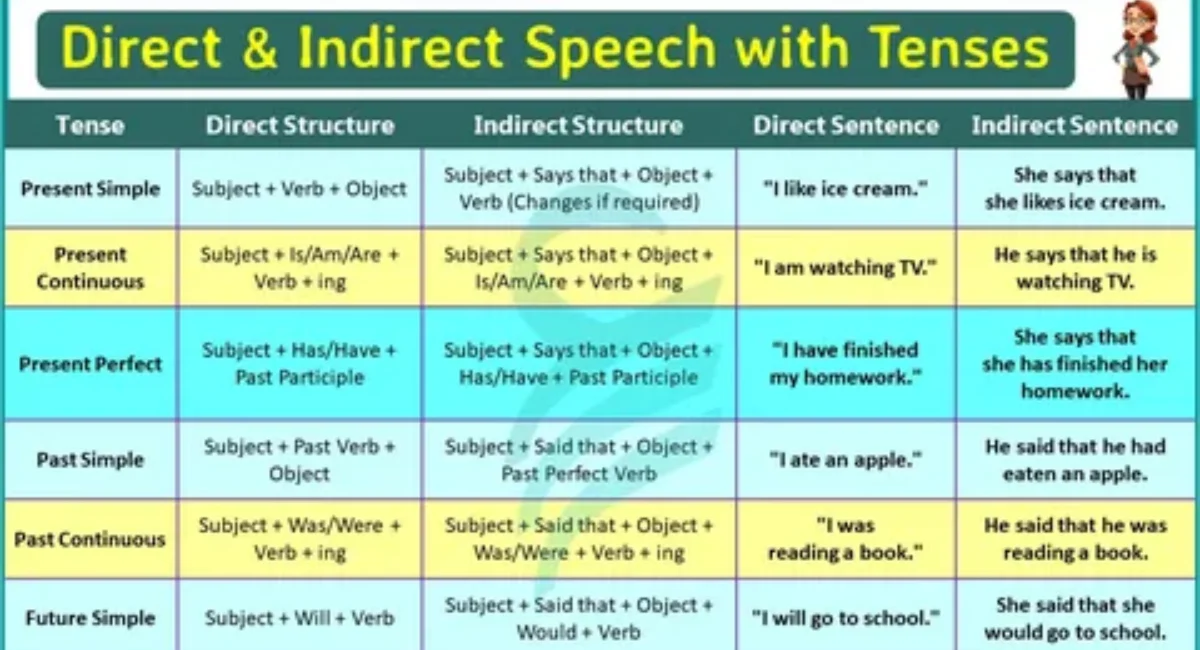
When the reporting verb (said, told, asked) is in the past tense, the tense of the original sentence usually moves one step back.
Tense Change Table
| Direct Speech | Indirect Speech |
| Present Simple | Past Simple |
| Present Continuous | Past Continuous |
| Present Perfect | Past Perfect |
| Past Simple | Past Perfect |
| Will | Would |
| Can | Could |
| May | Might |
Examples
- “I am hungry.” → She said she was hungry.
- “They are playing.” → He said they were playing.
- “I have finished my work.” → She said she had finished her work.
- “I will help you.” → He said he would help me.
📌 Teacher tip: If the reporting verb is in the present tense, no tense change is needed.
- She says, “I am ready.” → She says she is ready.
2. Pronoun Change Rules
Pronouns change to match the speaker and listener, not the original sentence.
Examples
- “I am late,” Tom said.
→ Tom said that he was late. - She said, “We are leaving.”
→ She said that they were leaving.
Common Pronoun Changes
| Direct | Indirect |
| I | he / she |
| we | they |
| my | his / her |
| our | their |
| me | him / her |
3. Time and Place Word Changes
Words related to time and place usually change in indirect speech.
Common Changes Table
| Direct Speech | Indirect Speech |
| now | then |
| today | that day |
| yesterday | the day before |
| tomorrow | the next day |
| last night | the night before |
| here | there |
| this | that |
Examples
- “I will go tomorrow.”
→ He said he would go the next day. - “She is here now.”
→ He said she was there then.
4. Reporting Statements (Simple Sentences)
For statements, we use:
said (that) or told + object (that)
Examples
- “I like coffee,” she said.
→ She said that she liked coffee. - “I am busy,” he told me.
→ He told me that he was busy.
📌 Note:
- said → no object
- told → must have an object (me, him, her)
Reporting Questions in Indirect Speech
When reporting questions, the sentence becomes a statement, not a question.
Key Rules
- Remove question marks
- Use if / whether for yes-no questions
- Use question words (what, where, why) for wh-questions
- No auxiliary verbs (do, does, did)
Yes/No Questions
- “Are you tired?” she asked.
→ She asked if I was tired. - “Did he call you?”
→ She asked whether he had called me.
Wh-Questions
- “Where do you live?”
→ He asked where I lived. - “Why are you late?”
→ She asked why I was late.
Reporting Commands and Requests
Commands and requests use:
told / asked + object + to-infinitive
Examples
- “Sit down,” the teacher said.
→ The teacher told us to sit down. - “Please help me,” she said.
→ She asked me to help her.
Negative Commands
- “Don’t touch it,” he said.
→ He told me not to touch it.
Reporting Suggestions and Advice
Suggestions often use suggested, advised, or recommended.
Examples
- “You should rest,” the doctor said.
→ The doctor advised me to rest. - “Let’s go for a walk,” she said.
→ She suggested going for a walk.
When Tenses Do NOT Change
Tenses usually stay the same when:
- The reporting verb is in the present
- The statement expresses a general truth
- The situation is still true
Examples
- He says, “The sun rises in the east.”
→ He says the sun rises in the east. - She said, “I live in Paris.” (still true)
→ She said she lives in Paris.
Common Mistakes Learners Make (And How to Avoid Them)
❌ Mistake 1: Keeping question word order
Learners often keep the original question structure when changing to reported speech.
Wrong: He asked where did I go.
✅ Correct: He asked where I went.
❌ Mistake 2: Forgetting to change pronouns
Another common problem is not adjusting pronouns to match the speaker.
Wrong: She said that I was tired.
✅ Correct: She said that she was tired.
❌ Mistake 3: Using “said” with an object
Remember that said is not followed directly by a person. Use told when there is an object.
Wrong: He said me that he was late.
✅ Correct: He told me that he was late.
Practice Sentences (Try Before Checking)
Convert these into indirect speech:
- “I am learning English,” she said.
- “Do you like pizza?” he asked me.
- “Don’t be late,” the teacher said.
Sample Answers:
- She said she was learning English.
- He asked me if I liked pizza.
- The teacher told us not to be late.
FAQ: Direct and Indirect Speech Rules (Schema-Ready)
What is the difference between direct and indirect speech?
Direct speech uses the speaker’s exact words in quotation marks. Indirect speech reports the meaning without exact words.
Do tenses always change in indirect speech?
No. Tenses do not change if the reporting verb is in the present or if the statement is a general truth.
What words are used to report questions?
We use asked, wanted to know, inquired, and words like if or whether for yes-no questions.
Can we use “that” in indirect speech?
Yes. “That” is optional and often omitted in spoken English.
Is indirect speech also called reported speech?
Yes. Indirect speech and reported speech mean the same thing.
Key Takeaways: Direct and Indirect Speech Rules
- Direct speech shows exact words; indirect speech reports meaning
- Tenses usually move one step back
- Pronouns and time words often change
- Questions become statements
- Commands use to-infinitive
- Practice is the fastest way to improve
Final Thought (Soft CTA)
Mastering direct and indirect speech rules takes time—but with clear rules and regular practice, it becomes natural. Try rewriting conversations you hear every day, and explore more grammar topics to build confident, fluent English step by step.