
English email writing is one of the most important skills in today’s world. Whether you are a student, a job seeker, or a working professional, you write emails almost every day. But many learners feel confused about how to start, what tone to use, and how to end an email correctly.
This complete guide will help you learn English email writing in a simple, clear, and practical way. You will see real-life examples, common mistakes, and easy practice sentences. The explanations are beginner-friendly but useful even for intermediate learners.
Sorry Generator
What Is English Email Writing?
English email writing means writing clear, polite, and effective messages in English using email. An email can be:
- Formal (to a boss, teacher, company)
- Semi-formal (to colleagues, clients you know)
- Informal (to friends, family)
Each type has its own style, words, and tone.
Why English Email Writing Is Important
Good email writing helps you:
- Communicate clearly
- Look professional and confident
- Avoid misunderstandings
- Create a good impression
Poor email writing can cause confusion, delay, or even rejection.
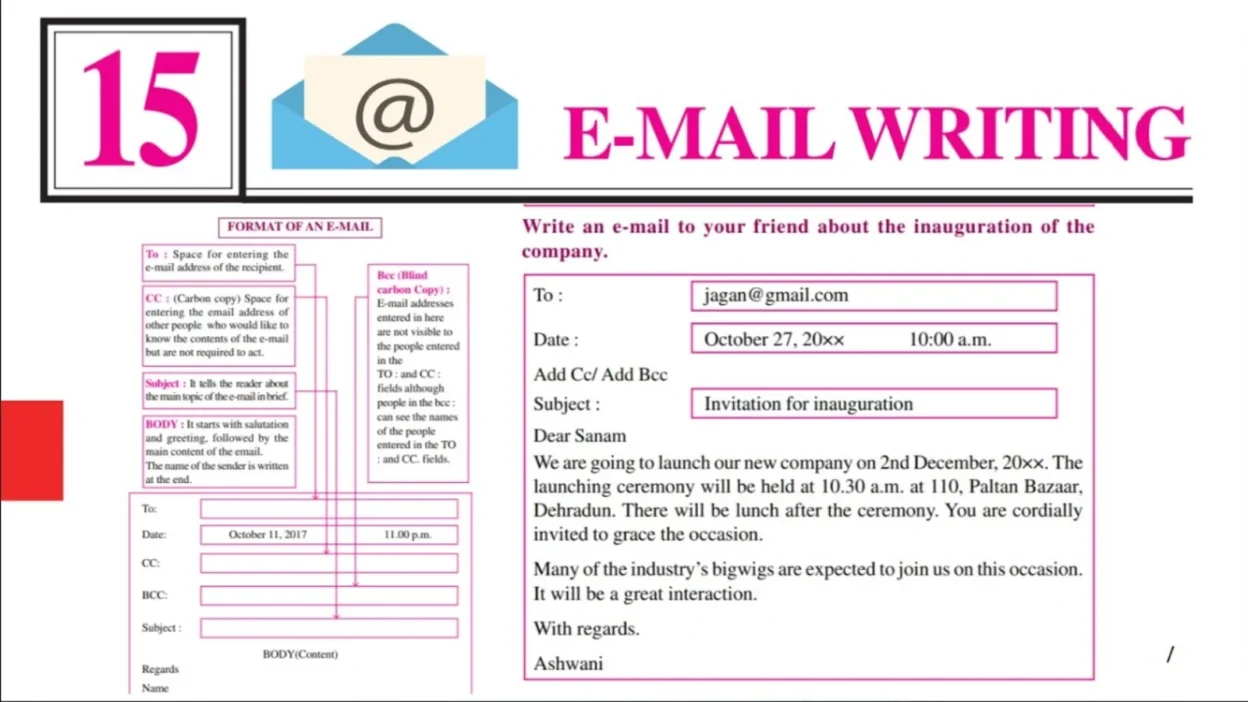
Basic Structure of an English Email
Every good email follows a simple structure.
| Part | Purpose |
| Subject line | Tells what the email is about |
| Greeting | Politely starts the email |
| Opening line | Explains why you are writing |
| Body | Gives details |
| Closing line | Ends politely |
| Sign-off | Your name |
Let’s understand each part in detail.
1. Subject Line in English Email Writing
The subject line should be short and clear. It tells the reader what the email is about.
Good Subject Line Examples
- Request for Leave on Monday
- Job Application for Sales Assistant
- Meeting Schedule Confirmation
Bad Subject Line Examples
- Hi
- Important
- Help
Tip: Use simple words. Avoid full sentences.
2. Greeting in English Emails
The greeting depends on how formal your email is.
Formal Greetings
- Dear Sir or Madam
- Dear Mr. Khan
- Dear Ms. Ali
Semi-Formal Greetings
- Dear Ahmed
- Hello Sara
Informal Greetings
- Hi Ali
- Hello
Common mistake:
❌ Dear friend
✔️ Hi my friend / Dear Ali
3. Opening Line (First Sentence)
The opening line explains why you are writing.
Formal Opening Lines
- I am writing to inform you about…
- I am writing to apply for…
- I am writing to request…
Semi-Formal Opening Lines
- I hope you are doing well.
- I wanted to ask about…
Informal Opening Lines
- Hope you’re doing well.
- Just wanted to let you know…
4. Email Body: Writing the Main Message
This is the most important part of English email writing.
Tips for a Good Email Body
- Keep sentences short
- Use simple words
- One idea per paragraph
- Be clear and polite
Example (Formal Email Body)
I would like to request leave for two days, from Monday to Tuesday, due to personal reasons. I will complete all my tasks before my leave.
5. Closing Line
The closing line prepares the reader for the end.
Common Closing Lines
- I look forward to your response.
- Thank you for your time and support.
- Please let me know if you need more information.
6. Sign-Off (Ending the Email)
Choose the sign-off carefully.
Formal Sign-Offs
- Yours sincerely
- Kind regards
- Best regards
Informal Sign-Offs
- Thanks
- Best
- Take care
Then write your name.
Types of English Emails (With Examples)
1. Formal Email Example
Subject: Job Application for Office Assistant
Dear Sir or Madam,
Revised Version:
I am writing to apply for the position of Office Assistant at your company. I have completed my graduation and possess basic computer skills. My CV is attached for your review. I look forward to your response.
Yours sincerely,
Another slightly more professional version:
I am writing to apply for the position of Office Assistant at your company. I have completed my graduation and have basic computer skills. Please find my CV attached for your review. I look forward to hearing from you.
Yours sincerely,
Yours sincerely,
Ali Khan
2. Semi-Formal Email Example
Subject: Meeting Update
Dear Ahmed,
I hope you are doing well. I wanted to inform you that the meeting has been rescheduled to Friday at 10 a.m.
Please let me know if this time works for you.
Best regards,
Sara
3. Informal Email Example
Subject: Catching Up
Hi Ali,
Hope you’re doing well. It’s been a long time since we last talked. Let’s meet this weekend if you’re free.
Take care,
Usman
Common English Email Writing Mistakes
1. Using Very Casual Language in Formal Emails
❌ Hey boss, I need leave
✔️ Dear Sir, I would like to request leave
2. Long Paragraphs
❌ One long block of text
✔️ Short, clear paragraphs
3. Spelling and Grammar Errors
Always check before sending.
4. Missing Subject Line
An email without a subject looks unprofessional.
Polite Phrases for English Email Writing
| Situation | Useful Phrases |
| Request | Could you please… |
| Asking information | I would like to know… |
| Apology | I apologize for the delay |
| Thanking | Thank you for your support |
Practice Sentences (Try Yourself)
Rewrite these in polite email English:
- Send me the details.
- I can’t come tomorrow.
- Give me an update.
Sample Answers
- Could you please send me the details?
- I am unable to attend tomorrow.
- Please provide me with an update.
English Email Writing for Students
Students often write emails to teachers and institutions.
Example: Email to a Teacher
Subject: Assignment Submission
Dear Teacher,
I hope you are well. I am writing to inform you that I have submitted my assignment today.
Thank you for your guidance.
Kind regards,
Ayesha
English Email Writing for Work
At work, clarity and politeness are very important.
Useful Workplace Email Tips
- Avoid emojis in formal emails
- Be respectful
- Stay professional
- Read before sending
English Email Writing Checklist
Before sending your email, ask yourself:
- Is the subject clear?
- Is the tone correct?
- Are there grammar mistakes?
- Is the message polite and clear?
FAQ: English Email Writing (People Also Ask)
What is the best way to start an email in English?
The best way is to use a polite greeting like “Dear Sir” for formal emails or “Hi” for informal ones.
How can I improve my English email writing skills?
Practice daily, read good email examples, and focus on simple and clear sentences.
Is grammar very important in email writing?
Yes. Correct grammar makes your email clear and professional.
How long should an English email be?
An email should be short and to the point. Avoid unnecessary details.
Can I use simple English in professional emails?
Yes. Simple English is better than complex English if the message is clear.
Key Takeaways: English Email Writing
- English email writing is a life skill
- Always use a clear structure
- Match your tone with the situation
- Keep sentences simple and polite
- Practice regularly to improve
Final Words (Soft CTA)
English email writing becomes easy with regular practice. Start by writing short emails every day, read good examples, and slowly improve your style..