
Sorry Generator
Introduction: Why English for Exams Matters
English for exams is not the same as daily spoken English. In exams, you are tested on accuracy, clarity, grammar, vocabulary, and structure. Many students understand English but still lose marks because they do not know exam patterns, common question types, or how answers are checked.
If you are preparing for school exams, board exams, competitive tests, or university entry exams, this guide will help you step by step. The explanations are simple, practical, and focused on what examiners actually want.
This article is written especially for beginner to intermediate learners who want to improve results, not just English knowledge.
What Does “English for Exams” Really Mean?
English for exams means learning English with a clear goal: getting marks.
It focuses on:
- Grammar accuracy
- Correct sentence structure
- Formal writing style
- Reading comprehension skills
- Vocabulary used in exams
- Avoiding common exam mistakes
Unlike casual English, exams require rules, formats, and precision.
Core Skills Needed for English Exams
To score well, you must work on four main areas.
1. Grammar (The Foundation)
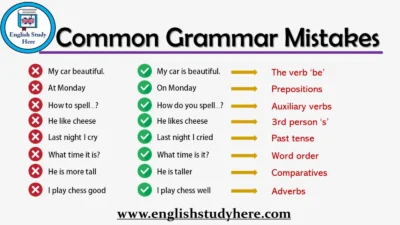
Grammar mistakes cost marks directly.
Important grammar topics for exams:
- Tenses (present, past, future)
- Subject–verb agreement
- Articles (a, an, the)
- Prepositions
- Active and passive voice
- Direct and indirect speech
- Modals (can, could, should, must)
Example:
❌ He go to school yesterday.
✅ He went to school yesterday.
2. Vocabulary for Exams
Exams prefer clear and correct words, not difficult words.
Focus on:
- Common academic words
- Synonyms and antonyms
- Word forms (noun, verb, adjective)
- Confusing words (affect/effect, advice/advise)
Example:
❌ The movie was very nice and very nice.
✅ The movie was interesting and enjoyable.
3. Reading Comprehension Skills
In exams, reading tests:
- Understanding main ideas
- Finding specific information
- Guessing meaning from context
Tips for exams:
- Read questions first
- Underline keywords
- Do not assume answers
- Answer from the passage only
4. Writing Skills for Exams
Writing is where many students lose marks.
Common exam writing tasks:
- Paragraph writing
- Essays
- Letters and emails
- Applications
- Short answers
Golden rule:
Simple + correct English = higher marks
English Grammar Rules You Must Know for Exams
Tenses (Quick Exam Guide)
| Tense | Use | Example |
| Present Simple | habits, facts | She plays cricket. |
| Present Continuous | happening now | She is playing cricket. |
| Past Simple | finished action | She played cricket. |
| Future (will) | decisions, promises | She will play cricket. |
Common mistake:
❌ I am knowing the answer.
✅ I know the answer.
Articles (a, an, the)
- a / an → first time, general
- the → specific or already known
Example:
❌ She bought pen.
✅ She bought a pen.
Subject–Verb Agreement
The verb must match the subject.
Example:
❌ He play football.
✅ He plays football.
English Writing Formats for Exams
Paragraph Writing (High-Scoring Format)
- Topic sentence
- Supporting ideas
- Example
- Conclusion
Example Paragraph:
My Favorite Teacher
My favorite teacher is Mr. Ali. He teaches English in our school. He explains lessons clearly and helps weak students. Because of him, I enjoy learning English.
Essay Writing (Simple Structure)
- Introduction
- Body (2–3 paragraphs)
- Conclusion
Exam Tip:
Do not use very long sentences. Clear ideas matter more than style.
Letter Writing (Formal Example)
Format:
- Address
- Date
- Subject
- Body
- Closing
Example Opening:
I am writing to inform you about…
Common English Exam Mistakes (And How to Avoid Them)
1. Over-complicated Language
❌ Trying to sound “too advanced”
✅ Use simple, correct sentences
2. Ignoring Instructions
❌ Writing more or less than required
✅ Follow word limits strictly
3. Grammar Repetition Errors
❌ Same mistake again and again
✅ Practice weak areas daily
4. Poor Time Management
❌ Spending too much time on one question
✅ Divide time before starting
Practice Sentences for Exam Preparation
Correct the sentences:
- She do not like coffee.
- I am living here since 2020.
- He gave me an advice.
Correct Answers:
- She does not like coffee.
- I have been living here since 2020.
- He gave me advice.
Vocabulary Commonly Used in English Exams
| Word | Meaning | Example |
| Advantage | benefit | Education has many advantages. |
| Disadvantage | drawback | Pollution is a disadvantage of cities. |
| Improve | make better | Practice improves skills. |
| Important | necessary | English is important for exams. |
How to Study English for Exams (Daily Plan)
30–45 minutes daily is enough if used correctly.
- 10 minutes: grammar practice
- 10 minutes: vocabulary
- 10 minutes: reading
- 10 minutes: writing
Weekly:
- Solve past papers
- Review mistakes
English for Exams: Real-Life Student Example
A student who failed English twice focused only on:
- Tenses
- Paragraph writing
- Past papers
Within 3 months, the student passed with good marks.
Lesson: Focused study beats random study.
FAQ: English for Exams (People Also Ask)
What is English for exams?
English for exams is focused English learning designed to help students score higher by mastering grammar, writing formats, and exam patterns.
How can beginners improve English for exams?
Beginners should focus on basic grammar, simple vocabulary, daily practice, and past exam questions.
Is spoken English important for exams?
Spoken English helps confidence, but exams mainly test written and reading skills.
How much vocabulary is enough for exams?
You do not need difficult words. Clear and correct vocabulary is enough to score well.
How long does it take to prepare English for exams?
With regular practice, noticeable improvement can be seen in 2–3 months.
Key Takeaways: English for Exams
- Exams test accuracy, not fluency
- Grammar is the backbone of exam English
- Simple English scores better than complex English
- Practice past papers regularly
- Learn from mistakes
Final Thoughts + Soft CTA
English for exams is a skill, not a talent. With the right rules, examples, and practice, anyone can improve. Start small, stay consistent, and focus on exam needs—not perfect.