
English grammar examples help learners understand how English really works in daily life. Instead of memorizing rules, you learn faster when you see clear examples, simple explanations, and common mistakes to avoid.
This guide is written for beginner to intermediate English learners. The language is simple, the explanations are short, and every rule comes with real-life English grammar examples you can use immediately.
By the end of this article, you will:
- Understand key English grammar rules
- See practical English grammar examples in context
- Avoid common learner mistakes
- Feel more confident using English in speaking and writing
Sorry Generator
What Is English Grammar? (Simple Explanation)
English grammar is the system of rules that shows how words are used to form sentences.
Grammar tells us:
- Word order (where words go)
- Verb forms (past, present, future)
- Sentence meaning (who does what)
Example:
- ❌ She go to school every day.
- ✅ She goes to school every day.
That small change (go → goes) is grammar.
Why English Grammar Examples Are Important
Rules alone can feel confusing. Examples show meaning clearly.
English grammar examples help you:
- Learn faster
- Remember rules longer
- Speak more naturally
- Write with confidence
Think of grammar rules as maps and examples as real roads.
Parts of Speech with English Grammar Examples
1. Nouns (Names of People, Places, Things)
A noun names something.
| Type | Examples |
| Person | teacher, Anna |
| Place | school, city |
| Thing | book, phone |
| Idea | happiness, freedom |
Example sentences:
- The book is on the table.
- Anna lives in this city.
2. Pronouns (Replace Nouns)
Pronouns replace nouns to avoid repetition.
| Pronoun | Example |
| I | I am learning English. |
| You | You look happy. |
| He | He works here. |
| She | She likes coffee. |
| They | They are friends. |
Common mistake:
- ❌ Anna said Anna is tired.
- ✅ Anna said she is tired.
3. Verbs (Action or State)
A verb shows action or being.
English grammar examples:
- Action: run, eat, write
- State: be, seem, feel
Example sentences:
- I eat breakfast at 8 a.m.
- She is tired today.
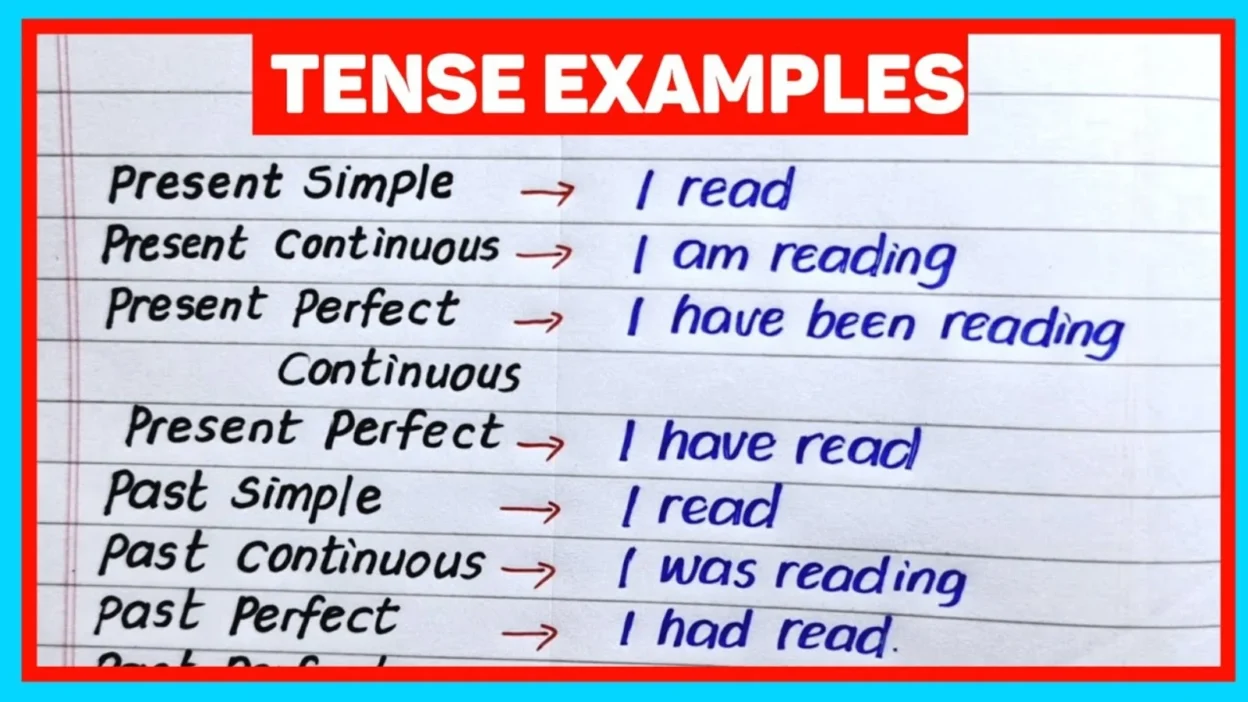
Verb Tenses with Clear English Grammar Examples
Present Simple (Daily habits, facts)
Structure: Subject + base verb (+ s/es)
Examples:
- I work from home.
- She works on Monday.
Common mistake:
- ❌ She work every day.
- ✅ She works every day.
Past Simple (Finished actions)
Structure: Subject + past verb
Examples:
- I watched a movie yesterday.
- They went home early.
Tip:
Regular verbs → -ed
Irregular verbs → special form (go → went)
Future (Will / Going to)
Will – decisions made now
Going to – plans already decided
Examples:
- I will call you later.
- She is going to study tonight.
Articles: A, An, The (Very Common but Tricky)
| Article | Use | Example |
| a | general, consonant sound | a book |
| an | general, vowel sound | an apple |
| the | specific | the book on the table |
Examples:
- I saw a dog.
- The dog was very friendly.
Prepositions with Easy English Grammar Examples
Prepositions show place, time, or movement.
Common prepositions:
| Preposition | Example |
| in | in the room |
| on | on the table |
| at | at 6 p.m. |
| to | go to school |
Example sentences:
- The keys are on the desk.
- I wake up at 7 a.m.
Common mistake:
- ❌ I am good in English.
- ✅ I am good at English.
Sentence Structure in English (Word Order)
Basic English sentence order:
Subject + Verb + Object
Examples:
- I like coffee.
- She reads books.
Wrong order (common mistake):
- ❌ Like I coffee.
- ✅ I like coffee.
Questions in English (With Examples)
Yes/No Questions
Use do / does / did
Examples:
- Do you like tea?
- Does she work here?
- Did they call you?
WH-Questions
| Word | Use |
| What | thing |
| Where | place |
| When | time |
| Why | reason |
| How | method |
Examples:
- Where do you live?
- Why are you late?
English Grammar Examples: Common Mistakes to Avoid
1. Missing “s” in third person
- ❌ He eat lunch at noon.
- ✅ He eats lunch at noon.
2. Wrong preposition
- ❌ Married with
- ✅ Married to
3. Double negatives
- ❌ I don’t know nothing.
- ✅ I don’t know anything.
Practice English Grammar Examples (Try Yourself)
Fill in the blanks:
- She ___ (go/goes) to work by bus.
- They ___ (was/were) late yesterday.
- I am good ___ English.
Answers:
- goes
- were
- at
English Grammar Examples for Daily Conversation
✅ Improved Version (More Variety)
At a café:
I’d like a coffee, please.
Could I see the menu, please?
At work:
The report will be finished today.
Could you help me with this task?
At home:
Dinner is going to be ready soon — I’m cooking tonight.
The TV is on the table.
✨ What Changed?
- Replaced “Can I have…” with “Could I see…”
- Changed “I will finish…” to “The report will be finished…”
- Combined ideas to avoid repeating “I” too often
- Kept natural, real-life English
FAQ: English Grammar Examples (People Also Ask)
What are English grammar examples?
English grammar examples are sample sentences that show how grammar rules work in real communication.
Why are examples better than rules?
Examples show meaning in context, making grammar easier to understand and remember.
How can beginners learn English grammar fast?
By studying simple rules, reading many English grammar examples, and practicing daily.
What grammar should I learn first?
Start with sentence structure, present tense verbs, nouns, pronouns, and prepositions.
Can I learn grammar without memorizing rules?
Yes. Learning through examples and practice is often more effective.
Key Takeaways: English Grammar Examples Made Simple
- Grammar rules explain how English works
- Examples show how English is really used
- Short sentences help beginners learn faster
- Practice daily with real-life English grammar examples
- Focus on common mistakes and correct usage
Final Thoughts
Learning grammar does not mean memorizing difficult rules. It means understanding how sentences work.