
English grammar is the foundation of English language learning. If you understand basic grammar, you can speak, write, read, and listen with more confidence. This guide is written for beginner to intermediate learners who want clear explanations, real-life examples, and practical help—without confusing rules.
Whether you are learning English for study, work, travel, or daily life, this article will help you build strong grammar skills step by step.
Sorry Generator
What Is English Grammar?
English grammar is the system of rules that explains how words are used together to make correct sentences.
Grammar tells us:
- Where to place words
- How to change words (walk → walked)
- How to show time, number, and meaning
Simple Example
- ❌ She go to school yesterday.
- ✅ She went to school yesterday.
Grammar helps your message sound clear and natural.
Why English Grammar Is Important for English Language Learning
Many learners try to speak English without grammar. This works a little—but not for long.
Good grammar helps you:
- Speak clearly and confidently
- Avoid misunderstandings
- Write emails, messages, and exams correctly
- Understand native speakers better
Think of grammar as the road map of the English language.
Parts of Speech (The Building Blocks of Grammar)
Every English sentence is made from parts of speech.
1. Nouns
Nouns name people, places, things, or ideas.
Examples:
- person: teacher, student
- place: school, city
- thing: book, phone
- idea: freedom, happiness
Sentence:
👉 The student reads a book.
2. Pronouns
Pronouns replace nouns to avoid repetition.
| Subject | Object | Possessive |
| I | me | my |
| you | you | your |
| he | him | his |
| she | her | her |
| they | them | their |
Example:
👉 Sara is my friend. She lives near me.
3. Verbs
Verbs show action or state.
Action verbs: run, eat, study
State verbs: be, seem, feel
Example:
👉 They are learning English.
4. Adjectives
Adjectives describe nouns.
Examples: big, small, easy, difficult
Word order tip:
👉 adjective + noun
- a good teacher
- an interesting book
5. Adverbs
Adverbs describe verbs, adjectives, or other adverbs.
Many adverbs end in -ly.
Examples: slowly, clearly, carefully
Sentence:
👉 She speaks English clearly.
Basic Sentence Structure in English
English follows a simple order:
Subject + Verb + Object (SVO)
Examples:
- I like coffee.
- She reads books.
- They play football.
Common Mistake
❌ Likes I coffee.
✅ I like coffee.
English Tenses Explained Simply
Tenses show time. Beginners should first master these three.
Present Simple Tense
Used for:
- daily routines
- facts
- habits
Structure:
Subject + base verb (+ s/es for he/she/it)
Examples:
- I work in an office.
- She works in an office.
Common mistake:
❌ She work every day.
✅ She works every day.
Past Simple Tense
Used for:
- finished actions in the past
Examples:
- I visited my friend yesterday.
- They watched a movie.
Irregular verb example:
- go → went
- eat → ate
Future (Going To)
Used for:
- plans
- intentions
Structure:
subject + am/is/are + going to + verb
Example:
👉 I am going to learn English grammar.
Articles: A, An, The (Very Important!)
Articles are small words, but they cause big problems for learners.
A / An
Used for one non-specific thing.
- a book
- an apple (before vowel sound)
The
Used for:
- specific things
- things already mentioned
Example:
👉 I bought a book. The book is very useful.
Prepositions Made Easy
Prepositions show place, time, or direction.
Common Prepositions
| Preposition | Use | Example |
| in | inside / months | in the room, in June |
| on | surface / days | on the table, on Monday |
| at | exact time/place | at 5 PM, at home |
Common mistake:
❌ I live on Pakistan.
✅ I live in Pakistan.
Asking Questions in English
Yes/No Questions
Use auxiliary verbs:
- do / does (present)
- did (past)
Examples:
- Do you like tea?
- Did she call you?
WH-Questions
Used to get information.
| Word | Use |
| what | thing |
| where | place |
| when | time |
| why | reason |
| how | method |
Example:
👉 Why are you learning English?
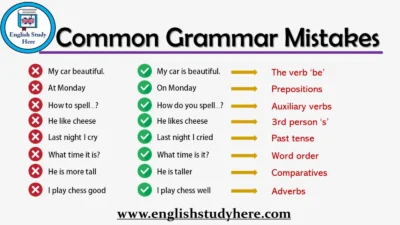
Common Grammar Mistakes in English Language Learning
1. Missing Verb “Be”
❌ She happy.
✅ She is happy.
2. Wrong Plural Forms
❌ Two child
✅ Two children
3. Confusing He / She
❌ My sister, he is a doctor.
✅ My sister, she is a doctor.
Practice Sentences (Featured Snippet Friendly)
Try to correct these sentences:
- She go to market every day.
- I am agree with you.
- He didn’t went there.
Correct Answers:
- She goes to the market every day.
- I agree with you.
- He didn’t go there.
Tips to Improve English Grammar Faster
- Read simple English articles daily
- Practice speaking short sentences
- Write 5–10 sentences every day
- Learn from mistakes (they are normal!)
- Focus on clear communication, not perfection
English Grammar and AI Search (2026 Tip)
Modern search engines and AI tools prefer:
- Clear explanations
- Natural language
- Real examples
That’s why simple grammar practice + real-life usage is the best way to learn English today.
Frequently Asked Questions (FAQ)
What is the best way to start English language learning?
Start with basic grammar, common words, and simple sentences. Practice every day for 15–30 minutes.
Is English grammar difficult for beginners?
No. English grammar is logical and simple if you learn it step by step with examples.
How long does it take to learn basic English grammar?
With daily practice, most learners understand basic grammar in 3–6 months.
Do I need perfect grammar to speak English?
No. You need clear grammar, not perfect grammar. Communication is more important.
Can I learn English grammar without a teacher?
Yes. With online resources, practice, and consistency, self-learning is very effective.
Key Takeaways (Quick Summary)
- English grammar is the foundation of English language learning
- Learn parts of speech and sentence structure first
- Focus on present, past, and future basics
- Practice daily with real-life examples
- Mistakes are part of learning—don’t fear them
Final Words
Learning English grammar is not about memorizing rules. It’s about understanding how English works in real life. Start small, practice often, and stay confident.