
English grammar for beginners is the foundation of clear speaking, writing, and understanding English. If you are learning English for study, work, or daily life, grammar helps you put words together correctly and confidently.
This guide is written in simple, clear English for non-native learners. It follows modern English education standards and is designed for Google 2026 SEO and AI search, including voice search and featured snippets.
You will learn:
- Basic grammar rules
- Real-life examples
- Common mistakes learners make
- Easy practice sentences
Let’s start from the basics and build step by step.
Sorry Generator
What Is English Grammar? (Simple Definition)
English grammar is the set of rules that explain how words are used to make correct sentences.
Grammar tells us:
- Where to place words
- How to change words for time (tense)
- How to ask questions
- How to express ideas clearly
Example
- ❌ She go to school every day
- ✅ She goes to school every day
That small change (go → goes) is grammar.
Why English Grammar Is Important in English Education
Grammar is not about memorizing rules. It is about clear communication.
Grammar helps you:
- Speak with confidence
- Write correct sentences
- Avoid misunderstandings
- Perform better in exams and interviews
In modern English education, grammar is taught with examples and usage, not just theory.
Parts of Speech (The Building Blocks)
Every English sentence is made from parts of speech.
1. Noun
A noun is a name of a person, place, thing, or idea.
Examples:
- person: teacher, student
- place: school, city
- thing: book, phone
- idea: happiness, freedom
Sentence:
👉 The student reads a book.
2. Pronoun
A pronoun replaces a noun.
| Noun | Pronoun |
| Ali | he |
| Sara | she |
| book | it |
| people | they |
Sentence:
👉 Sara is my friend. She is kind.
3. Verb
A verb shows action or state.
Action verbs: run, eat, write
State verbs: is, am, are, feel
Sentence:
👉 They are happy.
4. Adjective
An adjective describes a noun.
Examples: big, small, easy, difficult
Sentence:
👉 This is an easy lesson.
5. Adverb
An adverb describes a verb, adjective, or another adverb.
Often ends with -ly.
Examples: quickly, slowly, clearly
Sentence:
👉 She speaks English clearly.
6. Preposition
A preposition shows position or time.
Common prepositions: in, on, at, under, before
Sentence:
👉 The book is on the table.
Basic Sentence Structure (Very Important)
English follows this basic order:
Subject + Verb + Object
Examples
- I eat rice.
- She reads books.
- They play football.
Common Mistake
❌ Eat I rice
✅ I eat rice
Present Simple Tense (Daily Use)
We use the present simple tense for:
- Daily habits
- Facts
- Regular actions
Structure
Subject + base verb
But:
- Add -s / -es with he, she, it
Examples
- I work every day.
- She works in an office.
- He plays cricket.
Negative Form
do not / does not + verb
- I do not like tea.
- She does not like coffee.
Past Simple Tense (Talking About the Past)
We use the past simple tense for completed actions.
Regular verbs
Add -ed
- work → worked
- play → played
Irregular verbs
Change form
- go → went
- eat → ate
Examples
- I visited my friend yesterday.
- She went to school.
Future Simple Tense (Will)
Use will for future plans and decisions.
Structure
Subject + will + verb
Examples
- I will learn English.
- They will help you.
Articles: A, An, The
Articles are small words, but very important.
A / An (General)
- a → consonant sound
- an → vowel sound
Examples:
- a book
- an apple
The (Specific)
Use the when both people know the thing.
Example:
- The sun is hot.
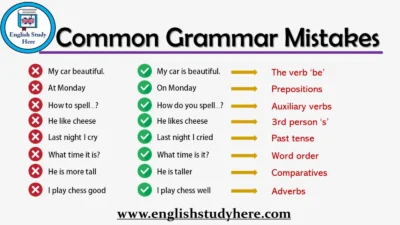
Common Grammar Mistakes (And Fixes)
1. Wrong Verb Form
❌ She go to market
✅ She goes to the market
2. Missing Articles
❌ I bought car
✅ I bought a car
3. Wrong Preposition
❌ Good in English
✅ Good at English
Grammar Practice Sentences
Try to understand and practice these sentences:
- I am learning English grammar.
- She studies English every day.
- We will improve our skills.
- They were happy yesterday.
👉 Tip from English education experts: Read sentences aloud to feel grammar naturally.
English Grammar Tips for Beginners
- Learn grammar with examples, not rules only
- Practice small sentences daily
- Read simple English stories
- Listen to spoken English (videos, podcasts)
- Do not fear mistakes – mistakes help learning
FAQ: English Grammar for Beginners (Schema-Ready)
What is the best way to learn English grammar?
The best way is to learn with simple examples, daily practice, and real-life sentences instead of memorizing rules.
Is English grammar difficult for beginners?
No. English grammar becomes easy when you start with basic rules and practice regularly.
How long does it take to learn basic English grammar?
With daily practice, beginners can understand basic grammar in 2–3 months.
Do I need perfect grammar to speak English?
No. Clear and simple grammar is enough for good communication.
Can I learn English grammar without a teacher?
Yes. With good resources, examples, and practice, self-learning is possible.
Key Takeaways (Quick Summary)
- English grammar is the foundation of English education
- Learn parts of speech and sentence structure first
- Practice tenses with daily examples
- Avoid common mistakes step by step
- Consistency is more important than speed
Final Words
Learning English grammar for beginners does not need to be stressful. Start small, practice daily, and use English in real life. Grammar improves naturally with time and use.