

English grammar for competitive exams is one of the most important scoring areas for students preparing for government jobs, entrance tests, and academic assessments. Whether you are studying for SSC, CSS, UPSC, banking exams, IELTS-based tests, or university entrance exams, a strong foundation in grammar can significantly improve your overall score.
This guide is designed for beginner to intermediate learners, especially non-native English speakers. The explanations are simple, practical, and exam-focused, with real-life examples and common mistakes explained clearly.
Sorry Generator
Why English Grammar Matters in Competitive Exams
English grammar is not just about rules—it is about clarity, accuracy, and confidence. In competitive exams, grammar questions are often:
- Easy to moderate level
- High-scoring
- Time-efficient if concepts are clear
Common Exams That Test English Grammar
- CSS, PMS, FPSC, PPSC
- SSC, Banking, Railways
- University entrance tests
- Teaching eligibility tests
- International exams with grammar sections
A good command of English grammar for competitive exams helps you:
- Avoid negative marking
- Improve reading comprehension
- Write accurate sentences
- Perform better in interviews and essays
Core Topics in English Grammar for Competitive Exams
Below are the most important grammar topics you must master. These are repeatedly tested across different exams.
Parts of Speech (The Foundation of Grammar)
Parts of speech tell us how a word functions in a sentence.
The 8 Main Parts of Speech
| Part of Speech | Example |
| Noun | book, teacher |
| Pronoun | he, they |
| Verb | run, is |
| Adjective | beautiful, tall |
| Adverb | quickly, very |
| Preposition | in, on |
| Conjunction | and, but |
| Interjection | wow, oh |
Example Sentence
She quickly finished her homework.
Common Mistake:
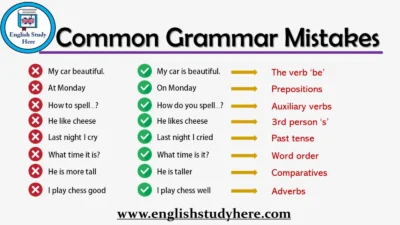
❌ She quick finished her homework.
✅ She quickly finished her homework.
Tenses (Most Asked Topic in Competitive Exams)
Tenses show the time of action. Many candidates lose marks due to tense confusion.
Types of Tenses
There are 12 tenses, grouped into:
- Present
- Past
- Future
Example: Present Simple Tense
Structure:
Subject + base verb (+ s/es)
Example:
- She works in an office.
- They play cricket daily.
Common Mistake:
❌ She work in an office.
✅ She works in an office.
Quick Tense Tip for Exams
If the sentence shows:
- Habit → Present Simple
- Action happening now → Present Continuous
- Finished action → Past Simple
Subject-Verb Agreement
The verb must agree with the subject in number and person.
Basic Rule
- Singular subject → singular verb
- Plural subject → plural verb
Examples
- She is happy.
- They are happy.
Tricky Exam Example:
Everyone is responsible for their actions.
Why?
“Everyone” is singular, even though it sounds plural.
Articles (A, An, The)
Articles are small words, but they carry big marks.
Types of Articles
- A / An → Indefinite
- The → Definite
Usage Examples
- I saw a cat.
- She ate an apple.
- The sun rises in the east.
Common Mistake:
❌ She is an honest girl.
✅ She is a honest girl. ❌
✅ She is an honest girl. ✔
(Because “honest” starts with a vowel sound)
Prepositions (Very Confusing but Scoring)
Prepositions show position, time, or direction.
Common Prepositions
- In, on, at
- By, with, for
- From, to, between
Time Prepositions
| Preposition | Usage |
| At | specific time |
| On | days, dates |
| In | months, years |
Examples:
- At 5 o’clock
- On Monday
- In 2026
Active and Passive Voice
Voice shows whether the subject does the action or receives it.
Active Voice
The teacher explained the lesson.
Passive Voice
The lesson was explained by the teacher.
Why It Matters in Exams
- Error correction questions
- Sentence transformation
- Comprehension passages
Direct and Indirect Speech
Also known as Narration, this topic appears frequently in exams.
Direct Speech
He said, “I am tired.”
Indirect Speech
He said that he was tired.
Common Change Rules
- Present → Past
- Today → That day
- Now → Then
Modals (Helping Verbs)
Modals express ability, permission, advice, or obligation.
Common Modals
- Can / Could
- May / Might
- Must / Should
Examples
- You must follow the rules.
- She can solve this question.
Exam Tip:
“Must” shows strong obligation, while “should” shows advice.
Common Errors Asked in Competitive Exams
Error Type 1: Wrong Tense
❌ He has went to school.
✅ He has gone to school.
Error Type 2: Preposition Error
❌ She is married with him.
✅ She is married to him.
Error Type 3: Article Error
❌ He is best player.
✅ He is the best player.
Practice Sentences (Exam-Oriented)
Try to correct these:
- She do not like coffee.
- He is working here since 2020.
- One of the boys have failed.
Answers:
- She does not like coffee.
- He has been working here since 2020.
- One of the boys has failed.
English Grammar for Competitive Exams: Smart Preparation Tips
- Study grammar rules with examples
- Practice daily short exercises
- Focus on commonly repeated mistakes
- Revise rules weekly
- Attempt mock tests
Frequently Asked Questions (FAQ)
What is the best way to learn English grammar for competitive exams?
Start with basics, learn rules with examples, and practice daily. Focus on common exam patterns.
Is English grammar difficult for beginners?
No. With simple explanations and regular practice, grammar becomes easy and scoring.
Which grammar topic is most important for exams?
Tenses, subject-verb agreement, articles, and prepositions are the most important.
How much time is needed to master grammar?
With daily practice of 30–45 minutes, basic grammar can be covered in 2–3 months.
Can grammar alone improve my exam score?
Yes. Grammar questions are usually direct and high-scoring if concepts are clear.
Key Takeaways (Quick Summary)
- English grammar for competitive exams is highly scoring
- Focus on rules + examples + practice
- Avoid common mistakes tested in exams
- Revise regularly and solve past papers
- Grammar builds confidence in reading and writing
Final Words
Mastering English grammar for competitive exams is not about memorizing rules—it is about understanding patterns and applying them correctly.