
English grammar lessons are the foundation of clear speaking, writing, and understanding. If you are a beginner or an intermediate learner, grammar can feel confusing at first—but it doesn’t have to be.
In this guide, you will learn English grammar lessons in a simple, friendly way. We will focus on how grammar works in real life, not just rules. You’ll see examples, common mistakes, and practice sentences you can use every day.
This article is written for non-native learners who want clear explanations, practical usage, and confidence when using English.
Sorry Generator
What Is Grammar and Why Is It Important?
Grammar is the system of rules that tells us how to form sentences. It helps us:
- Share ideas clearly
- Avoid misunderstandings
- Speak and write with confidence
- Sound more natural in English
Without grammar, English words are just noise. With grammar, they become meaning.
Example:
- ❌ Yesterday I go market
- ✅ Yesterday I went to the market.
The second sentence is clear because it follows grammar rules.
Core English Grammar Lessons You Must Learn First
If you are new to English, start with these essential grammar topics.
Parts of Speech (The Building Blocks)
Every English sentence uses parts of speech.
| Part of Speech | What It Does | Example |
| Noun | Names a person, place, or thing | dog, city |
| Verb | Shows action or state | run, is |
| Adjective | Describes a noun | big dog |
| Adverb | Describes a verb | run fast |
| Pronoun | Replaces a noun | he, she |
| Preposition | Shows place or time | in, on, at |
Example sentence:
She (pronoun) runs (verb) very (adverb) fast (adjective).
Sentence Structure: How English Sentences Work
One of the most important English grammar lessons is sentence order.
Basic English Sentence Pattern
Subject + Verb + Object
- I eat apples.
- She reads books.
This word order is very important in English.
Common mistake:
❌ Eat I apples.
✅ I eat apples.
Verb Tenses Made Simple
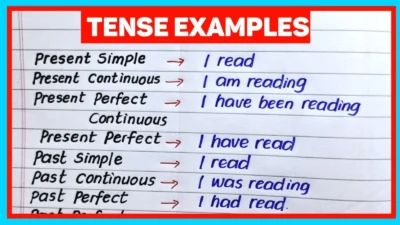
Verb tenses show time. Don’t try to learn all tenses at once. Start small.
Present Simple Tense
Used for:
- Daily routines
- Facts
- Habits
Form:
Subject + base verb (add -s for he/she/it)
Examples:
- I work every day.
- She works in an office.
Common mistake:
❌ She work every day.
✅ She works every day.
Past Simple Tense
Used for:
- Finished actions in the past
Examples:
- I watched a movie yesterday.
- They went home early.
Irregular verbs tip:
Some verbs change form (go → went, eat → ate). These must be memorized little by little.
Future with “Will”
Used for:
- Decisions made now
- Promises
Examples:
- I will call you later.
- She will help you.
Articles: A, An, and The (Easy Explanation)
Articles are small words but very important in English grammar lessons.
Indefinite Articles: A / An
Use when talking about something not specific.
- a → before consonant sounds
- an → before vowel sounds
Examples:
- a book
- an apple
Definite Article: The
Use when talking about something specific.
Examples:
- The book on the table is mine.
- The sun is bright today.
Common mistake:
❌ I go to the school every day (when talking generally)
✅ I go to school every day
Prepositions: Small Words, Big Meaning
Prepositions often confuse learners, but they follow patterns.
Common Time Prepositions
| Preposition | Use | Example |
| at | Exact time | at 7 PM |
| on | Days & dates | on Monday |
| in | Months, years | in 2026 |
Common Place Prepositions
- in → inside (in the room)
- on → surface (on the table)
- at → point (at the door)
Adjectives and Adverbs (Simple Rule)
Adjectives
Describe nouns.
- a big house
- a happy child
Adverbs
Describe verbs, often end in -ly.
- She speaks slowly
- He drives carefully
Common mistake:
❌ She runs quick
✅ She runs quickly
Questions and Negatives in English
Making Questions
Use helping verbs like do / does / did.
- Do you like coffee?
- Does she live here?
- Did they finish work?
Making Negative Sentences
Add not after the helping verb.
- I do not understand.
- She does not like tea.
- They did not come.
Common English Grammar Mistakes (And How to Fix Them)
Here are mistakes learners often make:
- Missing verb endings
- ❌ He eat rice
- ✅ He eats rice
- Wrong word order
- ❌ Very I like English
- ✅ I like English very much
- Overusing “the”
- ❌ The life is hard
- ✅ Life is hard
Practice English Grammar Lessons (Try Now)
Fill in the blanks:
- She ___ (work) on Mondays.
- We ___ (go) to the park yesterday.
- I will ___ (call) you later.
Answers:
- works
- went
- call
Practice a little every day. Short practice is better than long study sessions.
How to Learn English Grammar Faster (Real Tips)
From teaching real learners, these methods work best:
- Learn grammar in context, not alone
- Read simple English stories
- Listen to real conversations
- Speak, even if you make mistakes
- Review common errors weekly
Grammar improves when you use it, not when you memorize rules only.
FAQ: English Grammar Lessons (People Also Ask)
What are the basic English grammar lessons for beginners?
Start with sentence structure, present tense, past tense, articles, and common prepositions.
How long does it take to learn English grammar?
Basic grammar can be learned in 3–6 months with daily practice. Mastery takes longer.
Is English grammar hard for non-native learners?
English grammar is simpler than many languages, but practice and exposure are key.
What is the best way to practice English grammar?
Use short daily exercises, speak often, and correct mistakes gently.
Can I learn English grammar without memorizing rules?
Yes. Learning through examples, reading, and listening is very effective.
Key Takeaways: English Grammar Lessons Made Easy
- Grammar helps you communicate clearly
- Start with simple sentence patterns
- Learn verb tenses step by step
- Focus on common mistakes
- Practice daily with real examples
Final Thought
Learning English grammar is not about memorizing hundreds of complicated rules. It is about understanding how sentences work and using them in real life. Start small. Practice daily. Focus on clear communication, not perfection.