
Learning English grammar can feel confusing at first. Rules, exceptions, tenses, and sentence structures may seem overwhelming—especially for non-native learners.
This guide explains English grammar rules with examples in simple, clear English. It is designed for beginner to intermediate learners who want to speak, write, and understand English more confidently.
You will find:
- Easy explanations
- Real-life examples
- Common mistakes to avoid
- Practice sentences
- Quick tables for fast learning
Let’s start with the basics and build step by step.
Sorry Generator
What Is English Grammar?
English grammar is the system of rules that explains how words are used, changed, and combined to make correct sentences.
Grammar helps you:
- Speak clearly
- Write correctly
- Avoid misunderstandings
- Sound natural in English
Good grammar is not about being perfect. It is about being clear and confident.
Parts of Speech in English (The Building Blocks)
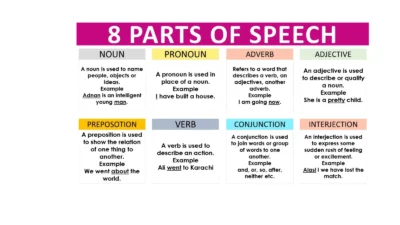
Every English sentence is made from parts of speech.
1. Nouns (Names of things)
A noun names a person, place, thing, or idea.
Examples:
- Person: teacher, Anna
- Place: school, city
- Thing: book, phone
- Idea: happiness, freedom
Example sentences:
- The teacher is kind.
- I bought a new phone.
Common mistake:
❌ I like musicS.
✅ I like music. (Music is uncountable)
2. Pronouns (Replace nouns)
A pronoun replaces a noun to avoid repetition.
| Pronoun | Example |
| I | I am learning English. |
| You | You look happy. |
| He | He is my friend. |
| She | She works here. |
| It | It is raining. |
| They | They are students. |
Common mistake:
❌ Me like coffee.
✅ I like coffee.
3. Verbs (Action or state)
A verb shows action or being.
Examples:
- Action: run, eat, write
- State: is, are, feel
Example sentences:
- She writes emails every day.
- They are tired.
Tip: Every English sentence needs a verb.
4. Adjectives (Describe nouns)
An adjective describes a noun.
Examples:
- big, small
- happy, sad
- fast, slow
Word order rule:
Adjective + Noun
✅ a red car
❌ a car red
5. Adverbs (Describe verbs)
An adverb describes how, when, or where something happens.
Many adverbs end in -ly.
Examples:
- quickly
- slowly
- carefully
Example sentence:
- She speaks slowly.
Basic English Sentence Structure
The Most Common Structure
Subject + Verb + Object
Example:
- I eat breakfast.
- She likes music.
Question Structure
Verb + Subject + Object
Example:
- Do you like coffee?
- Is she at home?
English Tenses Explained Simply
1. Present Simple Tense
Use it for:
- Daily routines
- Facts
- Habits
Structure:
- I / You / We / They + base verb
- He / She / It + verb + s
Examples:
- I work every day.
- She works in an office.
Common mistake:
❌ She work here.
✅ She works here.
2. Present Continuous Tense
Use it for:
- Actions happening now
Structure:
am / is / are + verb-ing
Examples:
- I am studying now.
- They are watching TV.
3. Past Simple Tense
Use it for:
- Finished actions in the past
Examples:
- I visited my friend yesterday.
- She watched a movie.
Irregular verb example:
- go → went
- eat → ate
4. Future Simple Tense
Use will for:
- Decisions made now
- Predictions
Examples:
- I will call you later.
- It will rain tomorrow.
Articles: A, An, The (Very Important!)
Indefinite Articles: A / An
Use for something not specific.
- a before consonant sounds: a book
- an before vowel sounds: an apple
Definite Article: The
Use for something specific or known.
Examples:
- I saw a dog. The dog was cute.
- The sun is bright.
Prepositions (Time & Place)
Common Prepositions
| Use | Preposition | Example |
| Time | at | at 5 o’clock |
| Time | on | on Monday |
| Time | in | in 2026 |
| Place | in | in the room |
| Place | on | on the table |
| Place | at | at the station |
Common mistake:
❌ I am in the bus.
✅ I am on the bus.
Subject-Verb Agreement
The verb must match the subject.
Examples:
- She likes tea.
- They like tea.
Rule:
Singular subject → verb + s
Plural subject → base verb
Countable and Uncountable Nouns
Countable Nouns
- Can be counted
- Have singular & plural
Examples: apple, car, book
Uncountable Nouns
- Cannot be counted
- No plural form
Examples: water, information, rice
❌ two informations
✅ two pieces of information
Common English Grammar Mistakes (And Fixes)
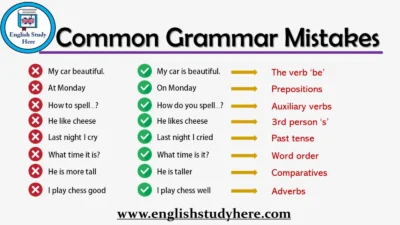
| Mistake | Correct |
| She don’t like it | She doesn’t like it |
| He go to work | He goes to work |
| I am agree | I agree |
| Very much happy | Very happy |
Practice Sentences (Try Yourself)
Fill in the blanks:
- She ___ (work/works) here.
- I ___ (am/is) learning English.
- They ___ (eat/ate) dinner last night.
- I have ___ apple.
Answers:
- works
- am
- ate
- an
FAQ: English Grammar Rules with Examples
What are the basic English grammar rules?
Basic rules include sentence structure, verb tenses, subject-verb agreement, and correct use of articles.
How can beginners learn English grammar easily?
Start with simple rules, practice daily, read examples, and focus on common mistakes.
Why is English grammar important?
Grammar helps you communicate clearly and avoid confusion when speaking or writing.
How long does it take to learn English grammar?
With daily practice, basics can be learned in 3–6 months. Mastery takes longer.
Is perfect grammar necessary to speak English?
No. Clear and understandable grammar is more important than perfection.
Key Takeaways
- Grammar helps you communicate clearly
- Start with basic sentence structure
- Learn tenses step by step
- Practice with real-life examples
- Mistakes are part of learning
Final Thoughts & Next Steps
Learning English grammar rules with examples does not have to be difficult. Focus on small steps, practice often, and use English in real situations.