

English grammar can feel confusing at first. Many learners think grammar is hard, full of rules, and impossible to remember. But the truth is simple:
👉 If you learn English grammar step by step, it becomes easy and logical.
This complete guide is designed for beginners and intermediate learners. We will explain English grammar in clear, simple English, using real-life examples, practice sentences, and common mistakes to avoid.
Whether you are learning English for speaking, writing, exams, or daily communication, this guide will help you build strong grammar foundations.
Sorry Generator
What Is English Grammar?
English grammar is the system of rules that explains how words are used to form sentences.
Grammar helps you:
- Speak clearly
- Write correctly
- Understand others easily
- Avoid confusion
Example
❌ She go to school every day.
✅ She goes to school every day.
One small grammar rule (verb agreement) changes the sentence from wrong to correct.
That’s why learning English grammar step by step is important.
Why Learn English Grammar Step by Step?
Many learners fail because they:
- Learn random topics
- Skip basics
- Memorize rules without practice
A step-by-step approach helps you:
- Build confidence
- Understand rules clearly
- Avoid common mistakes
- Learn faster and remember longer
Think of grammar like building a house.
You need a strong foundation before adding walls and a roof.
Step 1: Parts of Speech (The Building Blocks)
Parts of speech are the basic units of grammar. Every English sentence uses them.
Main Parts of Speech
| Part of Speech | Meaning | Example |
| Noun | Name of a person, place, or thing | book, Ali, city |
| Pronoun | Replaces a noun | he, she, they |
| Verb | Shows action or state | run, is, eat |
| Adjective | Describes a noun | big, happy |
| Adverb | Describes a verb | quickly, very |
| Preposition | Shows position | in, on, at |
| Conjunction | Joins words | and, but |
| Article | Limits a noun | a, an, the |
Example Sentence
👉 She (pronoun) is reading (verb) a (article) good (adjective) book (noun).
Step 2: Nouns (Names of Everything)
A noun names:
- A person (teacher)
- A place (school)
- A thing (pen)
- An idea (freedom)
Types of Nouns
- Common noun: boy, city
- Proper noun: Ali, Lahore
- Singular: book
- Plural: books
Common Mistake
❌ She has many book.
✅ She has many books.
Step 3: Pronouns (Avoid Repetition)
Pronouns replace nouns to make sentences natural.
Common Pronouns
- Subject: I, you, he, she, it, we, they
- Object: me, him, her, us, them
Example
❌ Ali is my friend. Ali is kind.
✅ Ali is my friend. He is kind.
Step 4: Verbs (Action and State)
A verb tells us:
- What someone does
- What happens
- A state of being
Examples
- Action: run, eat, write
- State: is, am, are
Verb Agreement (Very Important)
| Subject | Correct Verb |
| I | am |
| He / She / It | is |
| You / We / They | are |
Common Mistake
❌ He go to work.
✅ He goes to work.
Step 5: Tenses (Time in Grammar)
Tenses show when an action happens.
Basic Tenses (Beginner Level)
| Tense | Use | Example |
| Present Simple | Daily habits | I eat rice |
| Past Simple | Finished action | I ate rice |
| Future Simple | Future plan | I will eat rice |
Practice
- I study English every day.
- I studied English yesterday.
- I will study English tomorrow.
Step 6: Articles (a, an, the)
Articles are small but very important.
Usage
- a → before consonant sounds
- an → before vowel sounds
- the → specific things
Examples
- a book
- an apple
- the sun
Common Mistake
❌ She bought apple.
✅ She bought an apple.
Step 7: Adjectives (Describing Words)
Adjectives describe nouns.
Example
- a big house
- a happy child
Order of Adjectives
👉 opinion → size → color → noun
✔ a beautiful small red dress
Step 8: Adverbs (How Actions Happen)
Adverbs describe verbs.
Examples
- She speaks clearly
- He runs fast
Many adverbs end in -ly, but not all.
Step 9: Prepositions (Position & Time)
Prepositions show place, time, and direction.
Common Prepositions
- Time: at, on, in
- Place: in, on, under
Examples
- at night
- on Monday
- in the room
Common Mistake
❌ He is in Monday.
✅ He is on Monday.
Step 10: Sentence Structure
Basic English sentence order:
👉 Subject + Verb + Object
Example
- She eats rice.
- They play football.
Negative Sentences
- She does not eat rice.
- They do not play football.
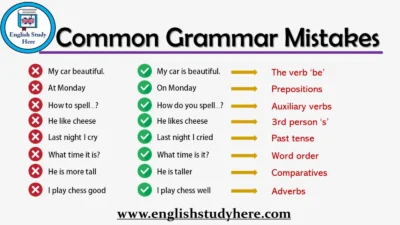
Common English Grammar Mistakes (And Fixes)
| Mistake | Correct |
| He don’t know | He doesn’t know |
| I am agree | I agree |
| She have a car | She has a car |
Practice Sentences (Try Yourself)
Fill in the blanks:
- She ___ (go/goes) to school.
- I ___ (am/is) happy.
- He bought ___ apple.
Answers:
- goes
- am
- an
English Grammar Step by Step for Daily Use
To improve fast:
- Read simple English daily
- Speak short sentences
- Practice one rule at a time
- Write and correct mistakes
Consistency is more important than speed.
Frequently Asked Questions (FAQ)
What is the best way to learn English grammar step by step?
Start with parts of speech, then verbs, tenses, and sentence structure. Practice daily with simple examples.
Is English grammar difficult for beginners?
No. English grammar becomes easy when explained simply and learned step by step.
How long does it take to learn basic English grammar?
With daily practice, beginners can learn basic grammar in 2–3 months.
Do I need perfect grammar to speak English?
No. Clear and correct basic grammar is enough for communication.
Should I memorize grammar rules?
Understand rules first, then practice. Memorizing alone is not effective.
Key Takeaways
- English grammar is logical, not scary
- Learn grammar step by step, not randomly
- Practice simple sentences daily
- Focus on common mistakes
- Use grammar in real-life situations
Final Words
Learning English grammar step by step is the smartest way to master English in 2026. You don’t need complex rules or difficult books. You need clear explanations, practice, and patience.