
English grammar can feel confusing at first—but it doesn’t have to be. With the right English grammar training, you can understand how sentences work, speak more clearly, and write with confidence.
This guide is written for beginner to intermediate learners. It uses simple English, short explanations, and real examples from daily life. Whether you are learning English for school, work, travel, or self-study, this article will help you build a strong grammar foundation.
Sorry Generator
What Is English Grammar?
English grammar is the system of rules that explains how we form sentences in English.
It tells us:
- How words change (walk → walked)
- How words are ordered (I eat apples, not I apples eat)
- How meaning changes with tense, number, and form
Think of grammar as the structure of a house. Vocabulary is the furniture, but grammar holds everything together.
Why English Grammar Training Is Important
Good grammar helps you:
- Speak more clearly and confidently
- Write emails, messages, and essays correctly
- Avoid misunderstandings
- Improve listening and reading skills
- Score better in English exams (IELTS, TOEIC, school tests)
Even native speakers follow grammar rules—often without thinking about them. With regular English grammar training, you can do the same.
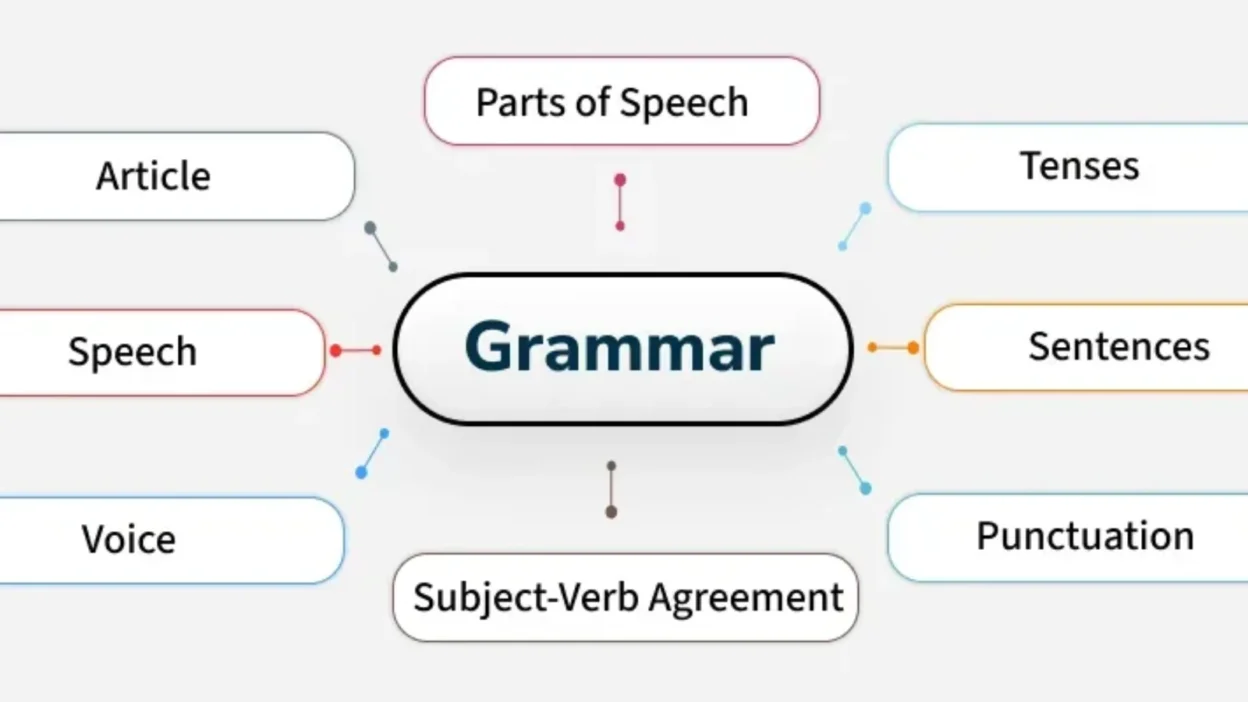
Basic Parts of English Grammar (Beginner Level)
Let’s start with the building blocks.
1. Parts of Speech (Word Types)
Every English word belongs to a group called a part of speech.
| Part of Speech | What It Does | Example |
| Noun | Names a person or thing | cat, city, teacher |
| Verb | Shows action or state | run, is, eat |
| Adjective | Describes a noun | big, happy |
| Adverb | Describes a verb | quickly, well |
| Pronoun | Replaces a noun | he, she, they |
| Preposition | Shows place or time | in, on, at |
| Conjunction | Connects words | and, but, because |
Example sentence:
She (pronoun) is (verb) very (adverb) happy (adjective) today (noun).
2. Sentence Structure (Word Order)
Basic English sentence order is:
Subject + Verb + Object
Examples:
- I like coffee.
- She reads books.
- They play football.
❌ Like I coffee.
✅ I like coffee.
This word order is very important in English grammar.
English Tenses Made Simple
Tenses show time: past, present, or future.
1. Present Simple (Daily habits, facts)
Form:
Subject + base verb (+ s for he/she/it)
Examples:
- I work every day.
- She works in an office.
- We live in London.
Common mistake:
❌ She work every day.
✅ She works every day.
2. Past Simple (Finished actions)
Form:
Subject + past verb
Examples:
- I watched a movie yesterday.
- They visited their parents.
Regular verbs: add -ed
walk → walked
Irregular verbs: change form
go → went
3. Future (Will vs Going to)
| Use | Example |
| Will (decisions now) | I will call you later. |
| Going to (plans) | I am going to study tonight. |
Articles: A, An, The (Very Common Problem)
Articles are small words, but they cause big problems for learners.
A / An (General, one thing)
- a book
- an apple (before vowel sounds)
The (Specific)
- the book on the table
- the sun
Examples:
- I bought a car. (any car)
- The car is red. (specific car)
Common mistake:
❌ She is teacher.
✅ She is a teacher.
Prepositions: In, On, At (Time & Place)
Prepositions are short words that show where or when.
Time Prepositions
| Preposition | Use | Example |
| at | clock time | at 7 o’clock |
| on | days/dates | on Monday |
| in | months/years | in 2026 |
Place Prepositions
- in the room
- on the table
- at the station
English Grammar Training for Intermediate Learners
Once you know the basics, it’s time to level up.
1. Present Perfect vs Past Simple
This is one of the most confusing topics.
| Tense | Use | Example |
| Past Simple | Finished time | I saw her yesterday. |
| Present Perfect | Life experience | I have seen her before. |
Key tip:
If you say when (yesterday, last year), use past simple.
2. Countable and Uncountable Nouns
Countable:
- apple → apples
- one book, two books
Uncountable:
- water
- money
- information
Examples:
- I have some water.
- I need two bottles of water.
❌ many informations
✅ much information
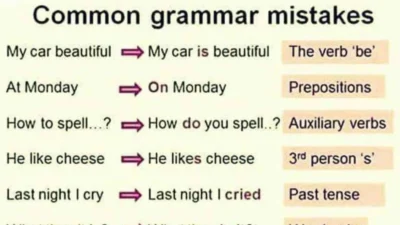
3. Common Grammar Mistakes to Avoid
Here are mistakes learners make again and again:
- ❌ He don’t like it.
✅ He doesn’t like it. - ❌ I am agree.
✅ I agree. - ❌ She explained me the problem.
✅ She explained the problem to me.
Real-Life English Grammar Examples
At Work
I have finished the report.
I will send it by email.
At School
The teacher gave us homework yesterday.
Daily Conversation
What are you doing right now?
I’m cooking dinner.
These examples show grammar as it is really used, not just rules on paper.
Practice Sentences (Try Yourself)
Fill in the blanks:
- She ___ (work) in a hospital.
- We ___ (see) that movie last week.
- I have never ___ (eat) sushi.
Answers:
- works
- saw
- eaten
Regular practice is the key to mastering English grammar.
How to Improve English Grammar Faster
Here are proven tips from real learners and teachers:
- Read short English texts daily
- Listen to simple English videos or podcasts
- Practice speaking, even alone
- Write short sentences every day
- Review your mistakes (very important!)
Consistency beats perfection.
English Grammar Training: Best Learning Approach
Instead of memorizing rules:
- Learn grammar in context
- Use examples from real life
- Practice a little every day
- Focus on common patterns
Grammar is a skill, not just knowledge.
FAQ: English Grammar (People Also Ask)
What is the best way to learn English grammar?
The best way is to combine clear explanations with daily practice. Learn rules, then use them in speaking and writing.
How long does it take to learn English grammar?
Basic grammar can take a few months. Advanced grammar takes longer and improves with regular use and exposure.
Is English grammar hard for beginners?
English grammar is not hard, but it is different from many languages. With step-by-step English grammar training, it becomes easier.
Should I study grammar or vocabulary first?
Study both together. Grammar helps you use vocabulary correctly in sentences.
Can I speak English without perfect grammar?
Yes. Communication is more important than perfection. Grammar improves clarity over time.
Key Takeaways: English Grammar Made Easy
- English grammar gives structure to language
- Start with basic sentence order and tenses
- Practice with real-life examples
- Learn from common mistakes
- Small daily practice brings big results
Final Thoughts
Learning English grammar is a journey, not a race. With the right English grammar training, simple explanations, and regular practice, you will see real progress.