
Sorry Generator
Introduction: Why English Grammar Tricks Matter
English grammar can feel confusing, especially for beginners and intermediate learners. Many rules look difficult, and exceptions make it worse. But here is the good news: you do not need to memorize every grammar rule.
With the right English grammar tricks, you can understand patterns, avoid common mistakes, and use English more confidently in real life.
In this guide, you will learn:
- Simple grammar tricks that actually work
- Easy explanations with real-life examples
- Common mistakes and how to fix them
- Practice sentences to improve faster
These tricks are useful for:
- Students
- Job seekers
- Spoken English learners
- Competitive exams
- Daily communication
Let’s make grammar easy, practical, and stress-free.
What Are English Grammar Tricks?
English grammar tricks are short, smart rules that help you:
- Remember grammar easily
- Apply rules correctly in speaking and writing
- Avoid confusion between similar structures
Instead of long definitions, grammar tricks focus on:
- Patterns
- Signals
- Keywords
- Common usage
Think of them as shortcuts to correct English.
Trick 1: Use “a” or “an” – The Sound Trick
The Simple Rule
Do not look at the letter. Listen to the sound.
- Use a before a consonant sound
- Use an before a vowel sound
Examples
- a book
- a university (starts with “you” sound)
- an apple
- an hour (silent “h” → vowel sound)
Common Mistake
❌ an university
✔️ a university
Trick 2: Past Simple vs Present Perfect – Time Trick
The Key Trick
Ask yourself one question:
Is the time finished or not?
| Situation | Use |
| Finished time | Past Simple |
| Unfinished time / experience | Present Perfect |
Examples
- I visited Lahore last year.
- I have visited Lahore many times.
Common Mistake
❌ I have seen him yesterday
✔️ I saw him yesterday
Trick 3: Much vs Many – Count Trick
Easy Rule
- Much → uncountable nouns
- Many → countable nouns
Examples
- much water, much money
- many books, many students
Real-Life Sentence
- There isn’t much time.
- There are many people waiting.
Trick 4: Few vs Little – Positive or Negative Meaning
Grammar Trick
| Word | Noun Type | Meaning |
| Few | Countable | Almost none (negative) |
| A few | Countable | Some (positive) |
| Little | Uncountable | Almost none (negative) |
| A little | Uncountable | Some (positive) |
Examples
- I have few friends. (sad)
- I have a few friends. (good)
Trick 5: Prepositions of Time – At, On, In
The Memory Trick
- At → exact time
- On → day or date
- In → month, year, long period
Examples
- at 5 o’clock
- on Monday
- in July
- in 2026
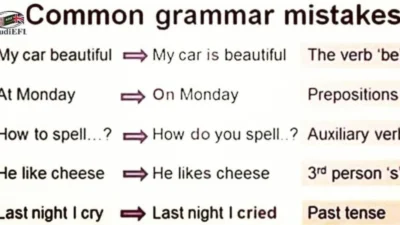
Common Mistake
❌ in Monday
✔️ on Monday
Trick 6: Since vs For – Time Duration Trick
Easy Difference
- Since → starting point
- For → period of time
Examples
- I have lived here since 2020.
- I have lived here for 5 years.
Trick 7: Active vs Passive Voice – Object Trick
Quick Test
If the object becomes more important, use passive voice.
Examples
- Active: She wrote the letter.
- Passive: The letter was written by her.
Common Use
- News
- Reports
- Formal writing
Trick 8: Adjective Order – OSASCOMP Trick
Easy Pattern
O S A S C O M P
| Order | Example |
| Opinion | beautiful |
| Size | small |
| Age | old |
| Shape | round |
| Color | red |
| Origin | Pakistani |
| Material | wooden |
| Purpose | study |
Example Sentence
- A beautiful small old round red Pakistani wooden study table
You don’t need to memorize all—just know opinion comes first.
Trick 9: Comparatives and Superlatives
Simple Trick
- Short adjectives → -er / -est
- Long adjectives → more / most
Examples
- tall → taller → tallest
- interesting → more interesting → most interesting
Common Mistake
❌ more better
✔️ better
Trick 10: Subject-Verb Agreement – Nearest Noun Trick
Easy Rule
The verb agrees with the real subject, not the nearest noun.
Examples
- The list of items is ready.
- The players are tired.
Trick 11: Articles with General vs Specific Meaning
Grammar Shortcut
- No article → general meaning
- The → specific meaning
Examples
- Books are useful. (general)
- The books on the table are mine. (specific)
Trick 12: Question Formation – Helping Verb Trick
Easy Formula
Helping verb + subject + main verb
Examples
- Do you like tea?
- Did she call you?
- Are they coming?
Common Mistake
❌ You like tea?
✔️ Do you like tea?
Common Grammar Mistakes Learners Make
Here are mistakes many learners repeat:
- Mixing tenses in one sentence
- Forgetting articles (a, an, the)
- Wrong prepositions
- Overusing present continuous
- Translating directly from native language
Tip
Think in English patterns, not word-by-word translation.
Practice Section: Try These Sentences
- She have finished her work.
- I am living here since 2022.
- He is more smarter than me.
Answers
- She has finished her work.
- I have lived here since 2022.
- He is smarter than me.
English Grammar Tricks for Speaking Confidence
- Use short sentences
- Focus on tense clarity
- Do not overthink rules
- Practice daily with real-life topics
Fluency comes from usage, not memorization.
FAQ: English Grammar Tricks (People Also Ask)
What are the best English grammar tricks for beginners?
Focus on tense signals, article usage, and basic sentence structure. Simple patterns work best.
How can I remember grammar rules easily?
Use grammar tricks, examples, and daily practice instead of long definitions.
Are grammar tricks enough for fluent English?
Grammar tricks help accuracy, but fluency needs speaking, listening, and real usage.
Which grammar topic is most important?
Tenses, subject-verb agreement, and articles are the most important for beginners.
Can grammar tricks help in exams?
Yes. They save time, reduce mistakes, and improve accuracy in MCQs and writing.
Key Takeaways: Quick Summary
- English grammar tricks make learning faster and easier
- Focus on sounds, time signals, and patterns
- Learn from mistakes and real-life examples
- Practice small sentences daily
- Accuracy improves confidence
Final Words (Soft CTA)
Grammar does not need to be scary. Start using these English grammar tricks in your daily speaking and writing. Practice a little every day, explore more grammar topics, and watch your confidence grow step by step..