
English language grammar is the system of rules that helps us make clear, correct sentences in English. If you are a beginner or an intermediate learner, grammar can feel confusing at first. But with simple explanations, real-life examples, and regular practice, it becomes much easier.
In this guide, you will learn the most important parts of English language grammar, explained in clear and simple English. We will look at sentence structure, tenses, parts of speech, common mistakes, and practical examples you can use in daily life.
This article is written like a friendly teacher talking to you—step by step, with no stress.
Sorry Generator
What Is English Language Grammar?
English language grammar is the set of rules that shows how words change and how they join together to make sentences.
Grammar helps you:
- Share ideas clearly
- Avoid misunderstandings
- Speak and write with confidence
- Sound more natural in English
Without grammar, sentences can be confusing or incorrect.
Example:
- ❌ She go to work yesterday.
- ✅ She went to work yesterday.
The second sentence follows correct grammar, so the meaning is clear.
Why English Grammar Is Important for Learners
Learning English grammar helps you in real-life situations, such as:
- Writing emails and messages
- Speaking at work or school
- Understanding books, videos, and conversations
- Passing English tests
Good grammar does not mean using difficult words. It means using the right structure.
Basic Sentence Structure in English
One of the most important grammar rules is sentence order.
Standard English Sentence Order
Most English sentences follow this pattern:
Subject + Verb + Object
| Part | Example |
| Subject | I |
| Verb | like |
| Object | coffee |
Sentence: I like coffee.
More examples:
- She reads books.
- They play football.
- We are students.
Common Mistake
- ❌ Like I coffee.
- ✅ I like coffee.
English word order is fixed, so changing it often sounds wrong.
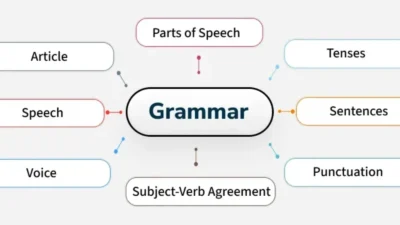
Parts of Speech in English Language Grammar
Parts of speech are the types of words we use in English. Understanding them makes grammar easier.
1. Nouns
Nouns name people, places, things, or ideas.
Examples:
- person: teacher, doctor
- place: school, city
- thing: phone, book
- idea: happiness, freedom
2. Pronouns
Pronouns replace nouns to avoid repetition.
Common pronouns: I, you, he, she, it, we, they
Example:
- Maria is my friend. She lives nearby.
3. Verbs
Verbs show actions or states.
Examples:
- actions: run, eat, write
- states: be, seem, feel
Example: They are happy.
4. Adjectives
Adjectives describe nouns.
Examples: big, small, interesting, blue
Example: She has a blue bag.
5. Adverbs
Adverbs describe verbs, adjectives, or other adverbs.
They often end in -ly.
Examples: quickly, slowly, very
Example: He speaks clearly.
English Tenses Explained Simply
Tenses show time. English has many tenses, but beginners can focus on a few main ones.
Present Simple Tense
Used for:
- daily habits
- facts
- routines
Structure:
Subject + base verb (+ s/es for he/she/it)
Examples:
- I work in an office.
- She drinks tea every morning.
Common mistake:
- ❌ She drink tea.
- ✅ She drinks tea.
Past Simple Tense
Used for completed actions in the past.
Structure:
Subject + past verb
Examples:
- I visited my friend yesterday.
- They watched a movie.
Irregular verb example:
- go → went
- eat → ate
Future (Will)
Used for decisions, promises, or predictions.
Structure:
Subject + will + base verb
Examples:
- I will call you later.
- She will help you.
Articles: A, An, and The
Articles are small words, but they are very important in English language grammar.
A / An (Indefinite Articles)
Used for something general or mentioned for the first time.
- a → before consonant sounds
- an → before vowel sounds
Examples:
- a book
- an apple
The (Definite Article)
Used for specific things.
Example:
- The book on the table is mine.
Common mistake:
- ❌ She is teacher.
- ✅ She is a teacher.
Prepositions: Small Words, Big Meaning
Prepositions show time, place, or direction.
Common Prepositions
| Preposition | Example |
| in | in the room |
| on | on the table |
| at | at home |
| to | go to school |
Examples:
- The keys are on the table.
- She arrived at 6 p.m.
Common English Grammar Mistakes (and Fixes)
1. Subject-Verb Agreement
- ❌ They is happy.
- ✅ They are happy.
2. Wrong Tense
- ❌ Yesterday I go to work.
- ✅ Yesterday I went to work.
3. Missing Articles
- ❌ I bought car.
- ✅ I bought a car.
4. Double Negatives
- ❌ I don’t know nothing.
- ✅ I don’t know anything.
Real-Life Grammar Examples (Daily English)
At Work
- I will send the email today.
- We had a meeting yesterday.
At Home
- She is cooking dinner.
- They are watching TV.
While Traveling
- Where is the station?
- I need a ticket.
These sentences use simple grammar but sound natural and correct.
Practice Sentences (Try It Yourself)
Fill in the blanks:
- She ___ (go/goes) to school every day.
- We ___ (watch/watched) a movie last night.
- I need ___ (a/an) umbrella.
Answers:
- goes
- watched
- an
Tips to Improve English Language Grammar Faster
- Read simple English books or articles
- Listen to podcasts or videos for learners
- Practice speaking every day
- Write short sentences and check them
- Learn from mistakes (they are normal!)
Consistency is more important than perfection.
Frequently Asked Questions (FAQ)
What is English language grammar in simple words?
English language grammar is the set of rules that helps us make correct and clear sentences in English.
Is English grammar hard to learn?
English grammar is not hard if you learn it step by step and practice regularly.
How can beginners improve English grammar?
Beginners can improve by reading simple texts, practicing basic tenses, and using English daily.
What is the most important grammar rule in English?
Word order (Subject + Verb + Object) is one of the most important rules.
How long does it take to learn English grammar?
It depends on practice, but basic grammar can be learned in a few months with regular study.
Key Takeaways: English Language Grammar
- Grammar helps you communicate clearly
- Start with basic sentence structure
- Learn common tenses and parts of speech
- Practice with real-life examples
- Mistakes are part of learning
Final Thoughts
Learning English language grammar is a journey, not a race. Focus on understanding, not memorizing rules. Use English every day, even in small ways, and your grammar will improve naturally.