
English words are the building blocks of the English language. If you want to speak, read, write, or understand English better, you must learn how English words work, how to use them correctly, and how to remember them in real life.
This guide is written for beginner to intermediate learners. The language is simple, the examples are practical, and the explanations are clear. You do not need to be an expert to understand this article.
By the end, you will know:
- What English words are
- How many types of English words exist
- How to learn and remember English words
- Common mistakes learners make
- How to practice English words daily
Sorry Generator
What Are English Words?
English words are units of meaning used to express ideas, actions, feelings, and information.
- Book
- Eat
- Happy
- Quickly
- Teacher
Each word has:
- A meaning
- A form (spelling)
- A use in a sentence
Real-Life Example
When you say:
I am learning English words every day.
You are using:
- I (who)
- am learning (action)
- English words (what you are learning)
- every day (time)
Why English Words Are Important
English words help you:
- Speak clearly
- Understand movies, books, and news
- Write emails and messages
- Pass exams
- Communicate confidently
Without enough English words, grammar alone is not enough.
Types of English Words (Parts of Speech)
English words are divided into parts of speech. Each type has a job in a sentence.
Noun (Naming Words)
Nouns name people, places, things, or ideas.
Examples:
- Person: teacher, boy
- Place: school, city
- Thing: phone, car
- Idea: love, freedom
Example sentence:
This book is very helpful.
Verb (Action or State Words)
Verbs show action or state.
Examples:
- Actions: run, eat, write
- States: is, feel, seem
Example sentence:
She reads English books.
Adjective (Describing Words)
Adjectives describe nouns.
Examples:
- big, small
- happy, sad
- easy, difficult
Example sentence:
He learned many new English words.
Adverb (How, When, Where)
Adverbs describe verbs, adjectives, or other adverbs.
Examples:
- quickly
- slowly
- very
- yesterday
Example sentence:
Pronoun (Replacing Nouns)
Pronouns replace nouns to avoid repetition.
Examples:
- I, you, he, she
- it, we, they
Example sentence:
Ali is my friend. He lives nearby.
Preposition (Position Words)
Prepositions show time, place, or direction.
Examples:
- in, on, at
- under, between
Example sentence:
The book is on the table.
Conjunction (Joining Words)
Conjunctions join words or sentences.
Examples:
- and
- but
- because
Example sentence:
I like English because it is useful.
Interjection (Expressing Feelings)
Interjections show emotions.
Examples:
- Wow!
- Oh!
- Oops!
Example sentence:
Wow! Your English is improving.
Common English Words Used Every Day
Here is a table of common English words with examples:
| Word | Meaning | Example Sentence |
| Learn | Get knowledge | I learn English daily. |
| Speak | Say words | She speaks clearly. |
| Easy | Not difficult | This lesson is easy. |
| Help | Assist | This guide helps me. |
| Practice | Do again | Practice English words. |
How to Learn English Words Effectively
Learning English words is easier when you use smart methods.
1. Learn Words in Context
Do not learn single words only. Learn them in sentences.
❌ Wrong:
Learn = seek knowledge
✅ Correct:
I want to learn English words.
2. Use English Words in Daily Life
- Talk to yourself in English
- Write short sentences
- Read simple English articles
3. Focus on Common English Words First
The most common 1000–2000 English words are used in daily conversation.
Example:
- go
- come
- make
- take
4. Repeat and Revise
Repetition helps memory.
Tip:
- Revise words after 1 day, 3 days, and 7 days
Practice Sentences with English Words
Try reading and understanding these sentences:
- I am learning new English words every week.
- These English words are easy to remember.
- She uses simple English words when she speaks.
- Reading books helps you learn English words faster.
Common Mistakes with English Words
Many learners make the same mistakes. Let’s fix them.
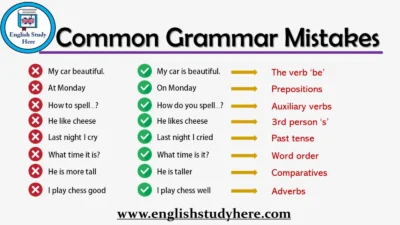
Mistake 1: Wrong Word Choice
❌ He did a mistake.
✅ He made a mistake.
Mistake 2: Confusing Similar Words
Examples:
- say / tell
- much / many
- big / large
Correct usage:
She told me the truth.
I have many books.
Mistake 3: Direct Translation from Native Language
Avoid translating word by word.
❌ I am agree.
✅ I agree.
English Words for Speaking Practice
Use these daily speaking sentences:
- Can you explain this word?
- What does this English word mean?
- I am trying to improve my vocabulary.
- Please speak slowly.
These sentences are voice-search friendly and natural.
English Words vs Vocabulary: Is There a Difference?
Yes, a small difference.
- English words: individual units (book, eat, happy)
- Vocabulary: total words you know
Example:
My English vocabulary is growing because I learn new English words daily.
How Many English Words Should You Learn?
You do not need all English words.
Approximate guide:
- 500 words → basic understanding
- 1500 words → daily conversation
- 3000 words → comfortable speaking
- 5000+ words → advanced level
Focus on quality, not quantity.
Featured Snippet: Easy Definition of English Words
English words are the basic units of the English language used to express meaning, ideas, actions, and feelings in spoken and written communication.
FAQ: English Words (People Also Ask)
What are English words?
English words are units of language that carry meaning and are used to form sentences in English.
How can beginners learn English words easily?
Beginners should learn common English words with examples, practice daily, and use words in real-life sentences.
How many English words are enough for daily use?
Around 1500–2000 English words are enough for daily conversation and basic understanding.
What is the best way to remember English words?
Learning words in context, repeating them, and using them in speaking and writing is the best method.
Why do I forget English words quickly?
This happens when you do not revise or use the words regularly. Practice and repetition solve this problem.
Key Takeaways: English Words
- English words are essential for communication
- Learn words with meaning and examples
- Focus on common, daily-use English words
- Avoid direct translation mistakes
- Practice speaking and writing regularly
Final Thoughts & Soft CTA
Learning English words is a journey, not a race. Start small, practice daily, and use English words in real life. Over time, your confidence will grow naturally.