

Learning English grammar can feel confusing at first. Many ESLC learners know words but feel unsure how to build correct sentences. That’s why grammar exercises for ESLC are so important. They help you practice step by step, gain confidence, and use English naturally in real life.
This guide is written for beginner to intermediate ESLC learners. The explanations are clear, short, and practical. You will see real-life examples, simple rules, and exercises you can try right away.
Sorry Generator
What Are Grammar Exercises for ESLC?
Grammar exercises for ESLC are practice activities designed to help English learners understand and use grammar correctly.
They usually focus on:
- Sentence structure
- Verb tenses
- Articles (a, an, the)
- Prepositions
- Question forms
- Common mistakes learners make
These exercises are not just about rules. They help you:
- Speak more clearly
- Write better sentences
- Understand native speakers more easily
Why Grammar Practice Is Important for ESLC Learners
Many learners try to memorize grammar rules, but practice is what makes grammar stick.
Grammar exercises help you:
- Turn rules into habits
- Notice patterns in English
- Avoid repeating the same mistakes
- Feel more confident when speaking
Think of grammar like muscle training. Reading rules is helpful, but doing exercises builds strength.
Basic Sentence Structure (Beginner Level)
English Sentence Order
English usually follows this order:
Subject + Verb + Object
Examples
- I eat apples.
- She likes coffee.
- They play football.
Common ESLC Mistakes
❌ Eat I apples.
❌ She coffee likes.
Practice Exercise
Choose the correct sentence:
- a) Likes she tea
b) She likes tea ✅ - a) They play games
b) Play they games ❌
Verb “To Be” Exercises (Am / Is / Are)
The verb to be is one of the most important verbs in English.
| Subject | Verb |
| I | am |
| You | are |
| He / She / It | is |
| We / They | are |
Examples
- I am a student.
- She is tired.
- They are happy.
Common Mistakes
❌ She are my friend.
❌ I is ready.
Practice Exercise
Fill in the blanks:
- I ___ happy today.
- They ___ from Canada.
- He ___ my teacher.
Answers: am, are, is
Present Simple Tense Exercises
We use the present simple for:
- Daily routines
- Facts
- Habits
Structure
- I / You / We / They + verb
- He / She / It + verb + s
Examples
- I work every day.
- She works on Monday.
- They live in Seoul.
Common Mistakes
❌ She work every day.
❌ He go to school.
Practice Exercise
Choose the correct form:
- She (eat / eats) breakfast at 7.
- They (play / plays) soccer.
Answers: eats, play
Articles: A, An, The
Articles are small words, but very important.
When to Use “A” and “An”
- Use a before consonant sounds
- Use an before vowel sounds
Examples:
- a book
- an apple
- an hour (silent “h”)
When to Use “The”
Use the when:
- The listener knows what you mean
- There is only one
Example:
- The sun is bright.
- I like the book you gave me.
Common Mistakes
❌ I have car.
❌ She is teacher.
Practice Exercise
Fill in the blanks:
- I bought ___ umbrella.
- She has ___ dog.
- ___ moon is bright tonight.
Answers: an, a, the
Prepositions of Place (In / On / At)
Prepositions show where something is.
| Preposition | Use |
| In | inside |
| On | on a surface |
| At | a point or place |
Examples
- The keys are in the bag.
- The phone is on the table.
- She is at home.
Common Mistakes
❌ I am in home.
❌ The book is at the table.
Practice Exercise
Choose the correct word:
- The cat is ___ the box.
- I am ___ the bus stop.
Answers: in, at
Making Questions in English
Yes / No Questions
Use:
Auxiliary verb + subject + main verb
Examples:
- Do you like coffee?
- Does she work here?
- Are they ready?
Wh-Questions
Words like:
- What
- Where
- When
- Why
- How
Examples:
- Where do you live?
- What does he do?
Common Mistakes
❌ You like coffee?
❌ Where you live?
Practice Exercise
Fix the sentence:
- You speak English?
- Where she works?
Answers:
- Do you speak English?
- Where does she work?
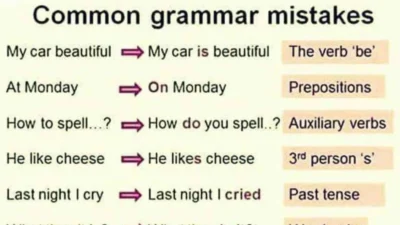
Common Grammar Mistakes ESLC Learners Make
Here are mistakes many learners repeat — and how to fix them.
| Mistake | Correct |
| She don’t like it | She doesn’t like it |
| He go to work | He goes to work |
| I am agree | I agree |
| Very much tired | Very tired |
Tip: Keep a small notebook of your own mistakes. Review it weekly.
Short Grammar Exercises You Can Do Daily
5-Minute Daily Practice
- Write 3 sentences about your day
- Change them to questions
- Read them aloud
Example
- I work today.
- Do I work today?
Small daily practice is better than long study once a week.
Grammar Exercises for ESLC in Real Life
Try grammar practice outside the classroom.
- Read signs and menus
- Listen to simple podcasts
- Write short messages in English
- Speak slowly and clearly
Mistakes are normal. Practice makes progress.
FAQ: Grammar Exercises for ESLC (Schema-Ready)
What are the best grammar exercises for ESLC beginners?
The best exercises focus on sentence structure, verb “to be,” present simple tense, and basic articles with clear examples.
How often should ESLC learners practice grammar?
Short daily practice (10–15 minutes) is more effective than long weekly study.
Are grammar exercises important for speaking?
Yes. Grammar exercises help learners speak clearly and avoid confusion in real conversations.
What grammar topics should ESLC learners start with?
Start with basic sentence order, verb tenses, articles, and common verbs like “to be” and “to have.”
Can ESLC learners learn grammar without memorizing rules?
Yes. Practice-based grammar exercises help learners learn naturally through examples.
Key Takeaways
- Grammar exercises for ESLC build confidence and clarity
- Practice is more important than memorizing rules
- Focus on common structures first
- Make grammar part of daily life
- Mistakes are part of learning
Final Thought
Learning English grammar does not have to be stressful. With the right grammar exercises for ESLC, clear examples, and daily practice, you will improve step by step.