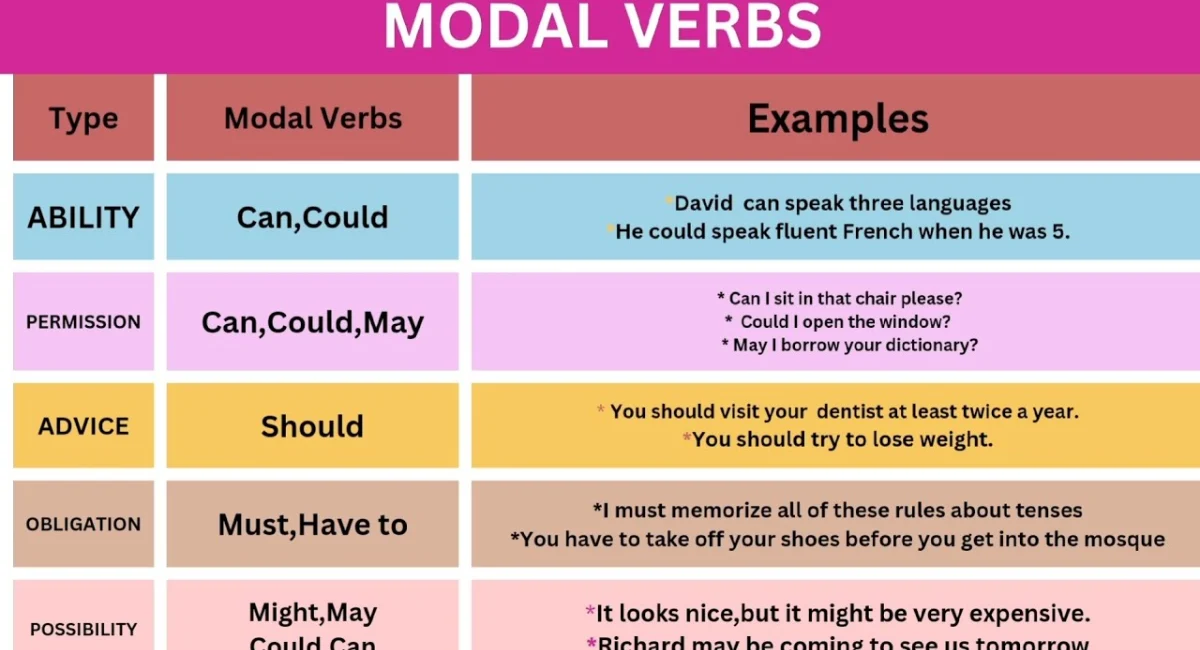
Modal verbs are small words, but they have big power in English. They help you talk about ability, permission, advice, possibility, obligation, and more.
If you have ever wondered when to use can, could, must, should, or might, this guide is for you.
In this complete beginner-friendly lesson, you will learn modal verbs rules with examples, common mistakes to avoid, and practice sentences you can use in real life.
Sorry Generator
What Are Modal Verbs?
Modal verbs are helping verbs. They come before the main verb and change its meaning.
They do not show action by themselves. Instead, they show attitude, intention, or level of certainty.
Common Modal Verbs in English
- can
- could
- may
- might
- must
- shall
- should
- will
- would
👉 Example:
- She can swim.
- You should study more.
Basic Modal Verbs Rules (Very Important)
Before learning meanings, you must understand the core rules.
Rule 1: Modal Verbs Do Not Change Form
Modal verbs are the same for all subjects.
❌ She cans swim
✅ She can swim
❌ He musts go
✅ He must go
Rule 2: Use the Base Form of the Verb
After a modal verb, always use the base verb (no to, no -s, no -ing).
❌ She can to drive
❌ He should studies
✅ She can drive
✅ He should study
Rule 3: No “Do / Does / Did” in Questions
Modal verbs make questions by changing position.
| Statement | Question |
| You can help me. | Can you help me? |
| She should go. | Should she go? |
Rule 4: Negatives Use “Not”
Add not after the modal verb.
- cannot / can’t
- should not / shouldn’t
- must not / mustn’t
👉 Example:
- You must not smoke here.
- He can’t come today.
Modal Verbs Rules With Meanings and Examples
Let’s look at each modal verb one by one with simple explanations and real-life examples.
Can – Ability, Permission, Possibility
Uses of “Can”
1. Ability
- I can speak English.
- She can cook very well.
2. Permission (informal)
- Can I sit here?
- You can use my phone.
3. Possibility
- It can be very hot in summer.
Could – Past Ability, Polite Requests, Possibility
Uses of “Could”
1. Past ability
- When I was young, I could run fast.
2. Polite requests
- Could you help me, please?
- Could I ask a question?
3. Weak possibility
- It could rain later.
👉 Could sounds more polite than can.
May – Permission and Formal Possibility
Uses of “May”
1. Permission (formal)
- May I come in?
- You may leave early.
2. Possibility
- She may arrive late.
📌 May is more formal than can or might.
Might – Small or Uncertain Possibility
Uses of “Might”
- I might go to the party.
- It might snow tonight.
👉 Use might when you are not sure.
Must – Obligation, Strong Necessity, Certainty
Uses of “Must”
1. Obligation
- You must wear a seatbelt.
- Students must follow the rules.
2. Strong certainty
- She isn’t answering. She must be busy.
⚠️ Must not means forbidden, not “not necessary”.
- You must not park here.
Should – Advice, Recommendation, Expectation
Uses of “Should”
1. Advice
- You should eat more vegetables.
- He should sleep earlier.
2. Expectation
- The train should arrive soon.
👉 Should is softer than must.
Will – Future, Decisions, Promises
Uses of “Will”
1. Future facts
- I will call you tomorrow.
2. Instant decisions
- I’m tired. I will rest now.
3. Promises
- I will help you.
Would – Polite Requests, Habits, Imaginary Situations
Uses of “Would”
1. Polite requests
- Would you like some coffee?
- Would you help me?
2. Past habits
- When we were kids, we would play outside.
3. Imaginary situations
- I would travel more if I had money.
Modal Verbs Comparison Table
| Modal Verb | Main Use | Example |
| Can | Ability | I can drive. |
| Could | Polite request | Could you help? |
| May | Formal permission | May I enter? |
| Might | Weak possibility | It might rain. |
| Must | Strong rule | You must stop. |
| Should | Advice | You should study. |
| Will | Future | I will call. |
| Would | Polite / unreal | I would help. |
Common Modal Verbs Mistakes (And Fixes)
❌ Don’t Use “To” After Modal Verbs
Modal verbs do not use “to” before the base verb.
❌ She can to dance.
✅ She can dance.
❌ He must to leave.
✅ He must leave.
Common modal verbs:
- can
- could
- may
- might
- must
- shall
- should
- will
- would
❌ Don’t Add “-s” or “-ed” to Modal Verbs
Modal verbs do not change form.
❌ He cans swim.
❌ She musted leave.
✅ He can swim.
✅ She must leave.
👉 Modal verbs stay the same for all subjects.
❌ Don’t Confuse “Must Not” and “Don’t Have To”
These two have very different meanings.
❌ You must not come.
👉 Meaning: It is forbidden.
✅ You don’t have to come.
👉 Meaning: It is not necessary.
Quick Difference:
- Must not = Not allowed
- Don’t have to = Not required
Practice Sentences (Try Yourself)
Fill in the blanks:
- You ___ wear a helmet when riding a bike.
- ___ I ask you a question?
- It ___ rain later, so bring an umbrella.
- You ___ eat so much sugar.
Possible answers: must, may/can, might, shouldn’t
Modal Verbs Rules for Questions (Quick Guide)
- Can you help me?
- Should I call her?
- Must we leave now?
- Would you like tea?
📌 No do / does / did needed.
FAQ: Modal Verbs Rules (People Also Ask)
What are modal verbs in simple words?
Modal verbs are helping verbs that show ability, advice, permission, or possibility, like can, should, and must.
What is the main rule of modal verbs?
After a modal verb, use the base form of the main verb without to.
Can we use two modal verbs together?
No. English does not allow two modal verbs in one clause.
❌ She must can go
✅ She must be able to go
What is the difference between can and could?
Can is more direct and present-focused. Could is more polite or refers to the past.
Is “must” stronger than “should”?
Yes. Must shows strong obligation. Should gives advice or recommendation.
Key Takeaways: Modal Verbs Rules
- Modal verbs do not change form
- Always use the base verb
- No to, no -s, no do/does
- Each modal shows a different level of certainty or force
- Practice using them in real-life sentences
Final Thoughts (Soft CTA)
Modal verbs become easy when you use them daily. Try writing 5 sentences today using can, should, and must.
Want to go deeper? Explore other English grammar topics and keep practicing—confidence comes with use!