
Understanding parts of speech in English grammar is one of the most important steps in learning English. If you know how words work in a sentence, English becomes clearer, easier, and more natural to use.
In this guide, we’ll explain English grammar in simple words, using real-life examples, short sentences, and common mistakes to help beginner and intermediate learners. By the end, you’ll understand how English sentences are built—and how to use them correctly in speaking and writing.
Sorry Generator
What Are Parts of Speech in English Grammar?
Parts of speech are categories that show how a word works in a sentence.
Think of a sentence like a football team ⚽
Each player has a role. In the same way, each word has a job.
For example:
She runs fast.
- She → who? (noun/pronoun)
- runs → action (verb)
- fast → how? (adverb)
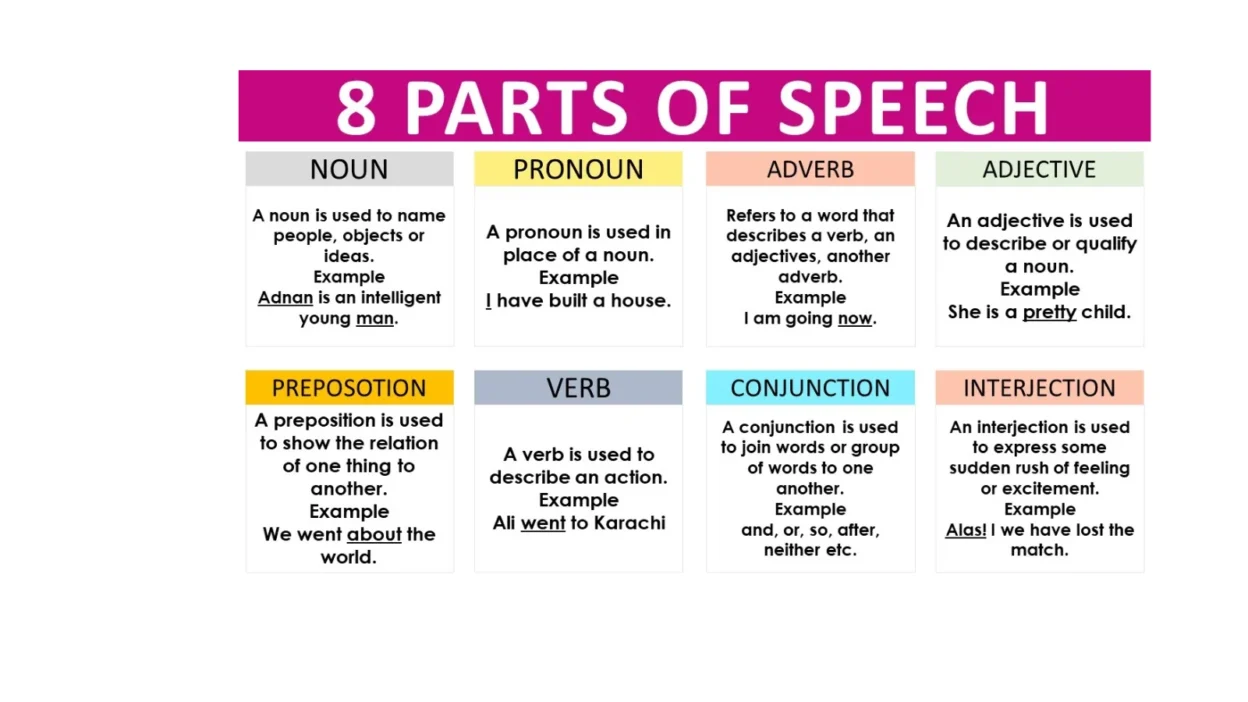
In English grammar, there are 8 main parts of speech (some books say 9). Let’s learn them one by one—in simple words.
The 8 Main Parts of Speech in English Grammar
| Part of Speech | What It Does | Example |
| Noun | Names a person, place, or thing | dog, city |
| Pronoun | Replaces a noun | he, they |
| Verb | Shows action or state | run, is |
| Adjective | Describes a noun | big, happy |
| Adverb | Describes a verb/adjective | quickly |
| Preposition | Shows relationship | in, on |
| Conjunction | Joins words or ideas | and, but |
| Interjection | Shows emotion | wow!, oh! |
Now let’s break each one down with examples you’ll actually use.
1. Nouns – Names of People, Places, and Things
A noun is the name of:
- a person (teacher, Maria)
- a place (school, India)
- a thing (book, phone)
- an idea (love, freedom)
Examples
- The dog is sleeping.
- Happiness is important.
- I live in London.
Types of Nouns (Simple List)
- Common nouns: boy, city
- Proper nouns: John, Paris
- Countable nouns: apple, chair
- Uncountable nouns: water, rice
Common Mistakes
❌ She has many informations.
✅ She has a lot of information.
2. Pronouns – Words That Replace Nouns
A pronoun is used instead of a noun to avoid repetition.
Common Pronouns
- I, you, he, she, it
- we, they
- my, his, her
- this, that
Examples
- Sara is my friend. She is kind.
- The phone is new. It is expensive.
Common Mistakes
❌ Me like coffee.
✅ I like coffee.
3. Verbs – Action or State Words
A verb tells us:
- what someone does
- or what something is
Action Verbs
- run, eat, write, speak
State (Being) Verbs
- is, am, are, was, were
Examples
- She writes emails.
- They are tired.
Common Mistakes
❌ She go to school.
✅ She goes to school.
4. Adjectives – Words That Describe Nouns
An adjective gives more information about a noun.
It can describe:
- size → big, small
- color → red, blue
- feeling → happy, sad
- quality → good, bad
Examples
- It’s a beautiful day.
- He bought a new car.
Important Rule
Adjectives do not change for plural nouns.
❌ She has blues eyes.
✅ She has blue eyes.
5. Adverbs – Words That Describe Actions
An adverb tells us:
- how?
- when?
- where?
- how often?
Many adverbs end in -ly, but not all.
Examples
- She speaks clearly.
- He arrived late.
- I always wake up early.
Common Mistakes
❌ She runs very quick.
✅ She runs very quickly.
6. Prepositions – Words That Show Relationship
A preposition shows the relationship between words—usually time, place, or direction.
Common Prepositions
- in, on, at
- under, over, between
- before, after
Examples
- The keys are on the table.
- She arrived at 7 PM.
- The cat is under the bed.
Common Mistakes
❌ She is married with him.
✅ She is married to him.
7. Conjunctions – Words That Join Ideas
A conjunction connects words, phrases, or sentences.
Common Conjunctions
- and
- but
- or
- because
- so
Examples
- I like tea and coffee.
- He was tired but happy.
- She stayed home because it was raining.
8. Interjections – Words That Show Emotion
An interjection expresses feeling or reaction.
Examples
- Wow! That’s amazing.
- Oh! I forgot my bag.
- Oops! My mistake.
Interjections are often followed by ! and used in informal English.
Featured Snippet Example: Parts of Speech Explained Simply
Parts of speech in English grammar are categories of words based on their function in a sentence, such as nouns, verbs, adjectives, and adverbs.
Practice Sentences (Try This!)
Identify the part of speech for the bold word:
- She bought a beautiful dress.
- They quickly finished the work.
- Wow! That’s surprising.
- The book is on the table.
(Answers at the end)
Common Mistakes Learners Make
- Confusing adjectives and adverbs
- Using wrong prepositions
- Forgetting verb agreement
- Overusing nouns instead of pronouns
Tip: Practice with short sentences first.
FAQ: Parts of Speech in English Grammar
What are the parts of speech in English grammar?
They are word categories like noun, verb, adjective, and adverb that show how words function in a sentence.
How many parts of speech are there in English?
There are 8 main parts of speech, though some sources include determiners as a separate category.
Why are parts of speech important?
They help you understand sentence structure, improve grammar, and speak or write English correctly.
Is learning parts of speech difficult?
No. With English grammar in simple words and examples, it becomes easy and logical.
Can one word be more than one part of speech?
Yes. Example:
- I cook dinner. (verb)
- The cook is busy. (noun)
Quick Summary: Key Takeaways
- Parts of speech show how words work in a sentence
- English has 8 main parts of speech
- Learning them improves speaking, writing, and understanding
- Practice with real-life examples for faster progress
Practice Answers
- beautiful → Adjective
- quickly → Adverb
- Wow → Interjection
- on → Preposition
Ready to Practice More? 🚀
Try writing 5 simple sentences and identify each part of speech. Explore more grammar topics to build strong, confident English—step by step!