
Prepositions in English grammar are small words, but they do big work.
They show place, time, direction, cause, and relationships between words in a sentence.
If you have ever wondered:
- Why do we say “in the morning” but “at night”?
- Why is it “on the bus” but “in the car”?
- How do I stop making mistakes with prepositions in English grammar?
You are in the right place.
This guide is written in simple, clear English for non-native learners, from beginner to intermediate level. You will find explanations, tables, real-life examples, common mistakes, and practice sentences you can use every day.
Sorry Generator
What Are Prepositions in English Grammar?
Prepositions in English grammar are words that show the relationship between a noun or pronoun and another word in the sentence.
They usually answer questions like:
- Where?
- When?
- How?
- Why?
Common examples of prepositions:
- in
- on
- at
- to
- from
- with
- for
- by
- about
- under
Example sentences:
- The book is on the table.
- She arrived at 6 p.m.
- He is talking to his teacher.
👉 The noun after a preposition is called the object of the preposition.
Why Are Prepositions So Important?
Prepositions are everywhere in English.
Without them:
- Sentences sound unnatural
- Meaning becomes unclear
- Even small mistakes can confuse listeners
Compare:
- ❌ I am waiting the bus
- ✅ I am waiting for the bus
One small word changes everything.
Common Types of Prepositions in English Grammar
Prepositions can be grouped by function. Let’s look at the most important types.
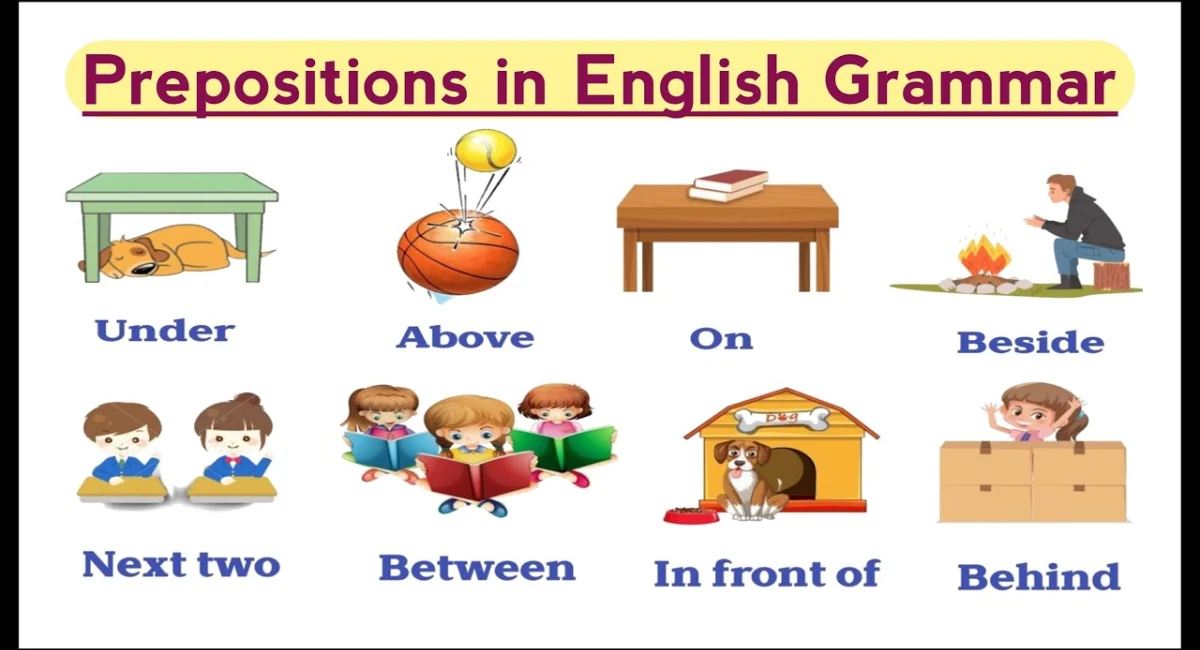
Prepositions of Place (Where?)
These prepositions tell us where something is.
Common prepositions of place
| Preposition | Use | Example |
| in | inside something | The keys are in my bag. |
| on | on a surface | The phone is on the desk. |
| at | a specific point | She is at the door. |
| under | below | The cat is under the chair. |
| between | in the middle of two | Sit between Tom and Anna. |
| behind | at the back | The car is behind the house. |
Real-life examples:
- I live in New York.
- There is a mirror on the wall.
- Let’s meet at the station.
📌 Tip:
Use at for specific points, on for surfaces, and in for enclosed spaces.
Prepositions of Time (When?)
These show when something happens.
The big three: in, on, at
| Preposition | Used for | Example |
| in | months, years, long periods | in June, in 2026 |
| on | days and dates | on Monday, on July 4 |
| at | exact times | at 7 o’clock |
More examples:
- I wake up at 6 a.m.
- We have a meeting on Friday.
- She was born in 2001.
Prepositions of Direction and Movement
These show movement from one place to another.
Common examples:
- to
- from
- into
- out of
- towards
- across
Example sentences:
- She walked to the office.
- He came from Spain.
- The dog ran into the room.
- We walked across the street.
⚠️ Common mistake:
❌ She went to inside the house
✅ She went into the house
Prepositions of Cause, Reason, and Purpose
These explain why something happens.
Common prepositions:
- because of
- due to
- for
- from
Examples:
- The flight was canceled because of the weather.
- He is famous for his music.
- She is tired from work.
Prepositions of Manner and Instrument (How?)
These show how something is done or what is used.
Examples:
- with
- by
- without
- using
Example sentences:
- She wrote the letter with a pen.
- He traveled by train.
- I can’t live without coffee ☕
Prepositional Phrases (Very Important!)
A prepositional phrase includes:
preposition + object
Examples:
- in the morning
- on the table
- at the bus stop
- with my friends
These phrases add details to sentences.
Example:
I studied at the library in the evening.
Common Preposition Combinations (Collocations)
English prepositions often follow fixed patterns. You must memorize them.
Verb + Preposition
| Verb | Preposition | Example |
| listen | to | Listen to music |
| wait | for | Wait for me |
| depend | on | Depend on him |
| believe | in | Believe in yourself |
Adjective + Preposition
- afraid of
- interested in
- good at
- married to
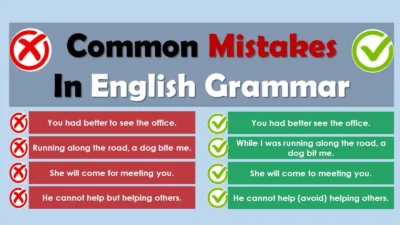
Common Mistakes with Prepositions in English Grammar
1. Using the wrong preposition
❌ She is married with a doctor
✅ She is married to a doctor
2. Translating directly from your language
❌ Discuss about the problem
✅ Discuss the problem
3. Adding extra prepositions
❌ Enter to the room
✅ Enter the room
📌 Teacher tip:
If you are unsure, check how native speakers use the phrase, not direct translation.
Practice Sentences (Try These!)
Fill in the blanks:
- The cat is ___ the sofa.
- We will meet ___ 5 p.m.
- She is interested ___ learning English.
- He walked ___ the park.
- I was born ___ April.
Answers:
- on / under
- at
- in
- through / into
- in
How to Learn Prepositions Faster (Pro Tips)
- Learn phrases, not single words
- Read short texts and notice patterns
- Listen to native speakers (videos, podcasts)
- Practice writing real sentences
- Keep a preposition notebook
Consistency beats memorization.
FAQ: Prepositions in English Grammar (People Also Ask)
What are prepositions in English grammar?
Prepositions are words that show the relationship between nouns and other words, often telling us where, when, or how something happens.
How many prepositions are there in English?
There are over 100 prepositions, but learners use about 30–40 most of the time.
Why are prepositions so hard to learn?
Because they don’t always follow clear rules and often differ from other languages.
Can a sentence end with a preposition?
Yes. In modern English, it is natural:
“Who are you talking to?”
What is the best way to practice prepositions?
Practice them in sentences, read daily, and notice how native speakers use them in context.
Key Takeaways: Prepositions in English Grammar
- Prepositions show relationships (place, time, direction, reason)
- Small words, big meaning
- Learn them in phrases, not alone
- Memorize common verb + preposition patterns
- Practice regularly with real-life examples
Final Thoughts (Soft CTA)
Prepositions in English grammar take time, patience, and practice—but you can master them.
Start small, practice daily, and don’t be afraid to make mistakes.