
Sorry Generator
Introduction: Present Tense Rules and Examples Explained Simply
Understanding present tense rules and examples is one of the most important steps in learning English. The present tense helps us talk about daily routines, habits, facts, feelings, and things happening now.
If you are a beginner or an intermediate learner, don’t worry. This guide explains English grammar in simple words, with clear rules, real-life examples, tables, and practice sentences. By the end, you will know when and how to use each present tense correctly.
What Is the Present Tense?
The present tense is used to talk about:
- Things that happen now
- Things that happen regularly
- Facts and general truths
- Planned events in the near future (in some cases)
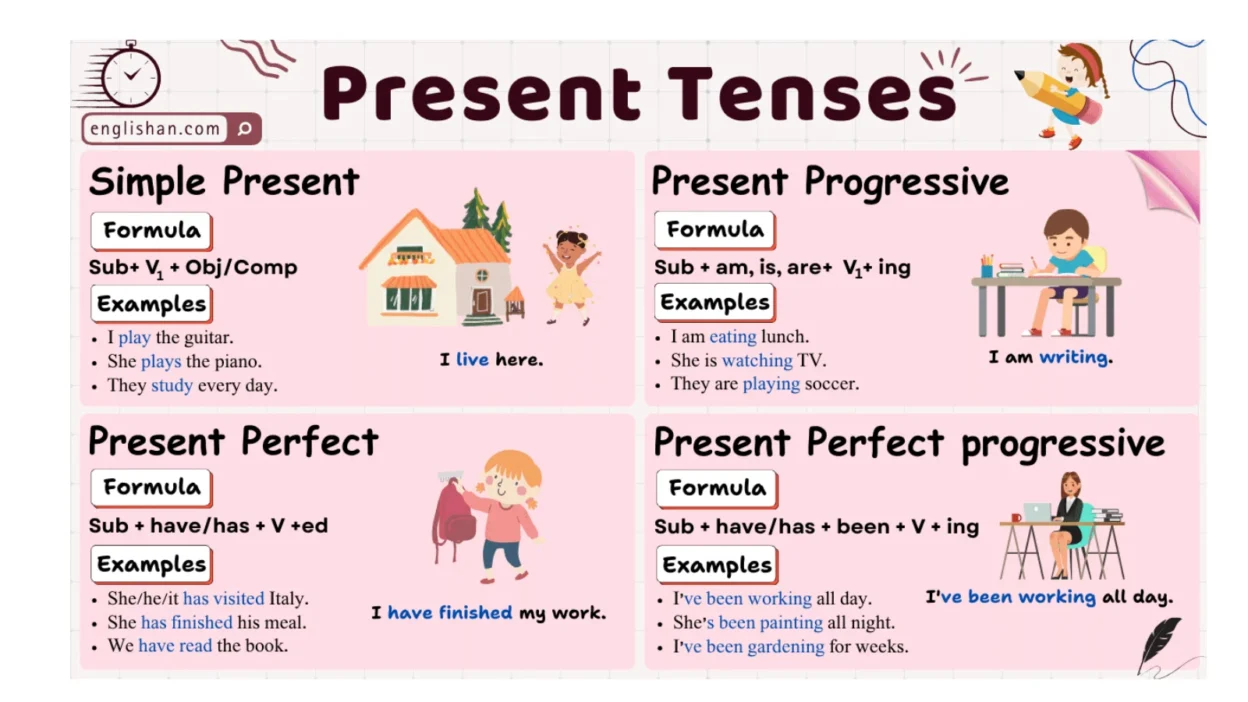
In English, there are four main present tenses:
- Present Simple
- Present Continuous (Present Progressive)
- Present Perfect
- Present Perfect Continuous
Let’s learn them one by one using easy rules and examples.
1. Present Simple Tense
When Do We Use the Present Simple?
We use the present simple tense to talk about:
- Daily habits and routines
- Facts and general truths
- Permanent situations
- Timetables and schedules
Present Simple Structure
| Sentence Type | Structure |
| Positive | Subject + base verb (+ s/es) |
| Negative | Subject + do/does not + base verb |
| Question | Do/Does + subject + base verb? |
Examples (Real-Life)
- I wake up at 7 a.m.
- She works in an office.
- We drink tea every morning.
- The sun rises in the east.
Negative Examples
- I do not like coffee.
- He does not play football.
Question Examples
- Do you speak English?
- Does she live here?
Common Mistakes
❌ She go to school every day.
✅ She goes to school every day.
2. Present Continuous Tense
When Do We Use the Present Continuous?
We use the present continuous tense to talk about:
- Actions happening right now
- Temporary situations
- Changing or developing situations
- Annoying repeated actions (with “always”)
Present Continuous Structure
| Sentence Type | Structure |
| Positive | Subject + am/is/are + verb + ing |
| Negative | Subject + am/is/are not + verb + ing |
| Question | Am/Is/Are + subject + verb + ing? |
Examples (Happening Now)
- I am reading a book.
- She is cooking dinner.
- They are studying English.
Temporary Situation Examples
- He is living in London these days.
- We are working on a new project.
Common Mistakes
❌ I am know the answer.
✅ I know the answer. (Use present simple for states)
Present Simple vs Present Continuous (Quick Comparison)
| Present Simple | Present Continuous |
| Daily habits | Happening now |
| Permanent facts | Temporary actions |
| I work daily | I am working now |
Example:
- I work in a bank. (permanent)
- I am working from home today. (temporary)
3. Present Perfect Tense
When Do We Use the Present Perfect?
We use the present perfect tense to talk about:
- Past actions with results in the present
- Life experiences
- Actions that started in the past and continue now
- Actions at an unspecified time
Present Perfect Structure
| Sentence Type | Structure |
| Positive | Subject + has/have + past participle |
| Negative | Subject + has/have not + past participle |
| Question | Has/Have + subject + past participle? |
Examples (Experience & Result)
- I have finished my homework.
- She has visited Paris.
- We have lived here for five years.
Common Time Words Used
- already
- yet
- just
- ever
- never
- for / since
Common Mistakes
❌ I have seen him yesterday.
✅ I saw him yesterday. (Use past simple with time)
4. Present Perfect Continuous Tense
When Do We Use the Present Perfect Continuous?
We use this tense to show:
- Actions that started in the past and are still happening
- Actions that recently stopped but show a result
- Focus on duration of action
Present Perfect Continuous Structure
| Sentence Type | Structure |
| Positive | Subject + has/have been + verb + ing |
| Negative | Subject + has/have not been + verb + ing |
| Question | Has/Have + subject + been + verb + ing? |
Examples (Duration Focus)
- I have been studying English for two years.
- She has been working all day.
- They have been waiting for an hour.
Common Mistakes
❌ I have been know him for years.
✅ I have known him for years.
Common Present Tense Signal Words
| Tense | Common Words |
| Present Simple | always, usually, often, every day |
| Present Continuous | now, at the moment, currently |
| Present Perfect | already, just, yet, ever |
| Present Perfect Continuous | for, since, all day |
Practice Sentences (Try Yourself)
Fill in the blanks:
- She ___ (read) a book now.
- We ___ (live) here since 2020.
- He usually ___ (wake) up early.
- They ___ (work) all morning.
Answers:
- is reading
- have lived
- wakes
- have been working
Common Present Tense Mistakes (And Fixes)
- Using -ing with stative verbs
- Forgetting -s / -es in third person
- Mixing past time words with present perfect
- Overusing continuous tense
FAQ: Present Tense Rules and Examples (Schema-Ready)
What is present tense in simple words?
The present tense shows actions happening now, regularly, or facts that are always true.
How many present tenses are there in English?
There are four: present simple, present continuous, present perfect, and present perfect continuous.
When should I use present simple?
Use it for daily habits, routines, facts, and permanent situations.
Can present tense talk about the future?
Yes. Present simple and present continuous can describe scheduled future events.
What is the easiest present tense for beginners?
The present simple tense is the easiest and most commonly used.
Key Takeaways (Quick Summary)
- Present tense talks about now, habits, and facts
- English has four present tenses
- Use present simple for routines
- Use present continuous for actions happening now
- Use present perfect for experience and results
- Use present perfect continuous for duration
Final Thoughts & Practice CTA
Mastering present tense rules and examples will make your English clearer and more natural. Start with the present simple, practice daily, and slowly add other tenses.