
Subject verb agreement rules are one of the most important parts of English grammar. If your subject and verb do not agree, your sentence sounds wrong—even if people still understand you.
The good news?
Once you understand the basic patterns, subject verb agreement becomes much easier.
This guide explains subject verb agreement rules in simple, clear English. It is designed for beginner to intermediate learners, especially non-native speakers. You will find:
- Easy explanations
- Real-life examples
- Common mistakes to avoid
- Practice sentences
- FAQs (People Also Ask style)
Let’s start from the basics and move step by step.
Sorry Generator
What Is Subject Verb Agreement?
Subject verb agreement means that the subject and the verb in a sentence must match in number.
- Singular subject → singular verb
- Plural subject → plural verb
Simple Examples
| Subject | Verb | Correct Sentence |
| She | runs | She runs fast. |
| They | run | They run fast. |
| The dog | barks | The dog barks loudly. |
| The dogs | bark | The dogs bark loudly. |
If the subject is one, the verb is singular.
If the subject is more than one, the verb is plural.
Why Subject Verb Agreement Rules Matter
Using correct subject verb agreement rules helps you:
- Sound natural and fluent
- Avoid grammar mistakes in exams
- Write professional emails and documents
- Speak confidently in daily conversations
Even small mistakes like “She go to school” can make your English sound incorrect.
Basic Subject Verb Agreement Rules (Core Rules)
Rule 1: Singular Subjects Take Singular Verbs
A singular subject refers to one person, place, thing, or idea.
Examples:
- He works in an office.
- The cat sleeps all day.
- My friend lives nearby.
📌 Tip: In the present simple tense, singular verbs often end in -s or -es.
Rule 2: Plural Subjects Take Plural Verbs
A plural subject refers to more than one person or thing.
Examples:
- They work in an office.
- The cats sleep all day.
- My friends live nearby.
Plural verbs do not end in -s in the present tense.
Subject Verb Agreement with “Be” Verbs
The verb to be is special and changes form often.
Present Tense
| Subject | Verb |
| I | am |
| He / She / It | is |
| You / We / They | are |
Examples:
- She is happy.
- They are ready.
- I am tired.
Past Tense
| Subject | Verb |
| I / He / She / It | was |
| You / We / They | were |
Examples:
- He was late.
- We were excited.
Subject Verb Agreement with Compound Subjects
Rule 3: Subjects Joined by “And” Are Usually Plural
When two subjects are connected by and, use a plural verb.
Examples:
- Tom and Jerry are friends.
- My brother and sister live here.
Exception
If the two subjects refer to one idea or one person, use a singular verb.
Examples:
- Bread and butter is my breakfast.
- The owner and manager is here.
Subjects Joined by “Or” / “Nor”
Rule 4: The Verb Agrees with the Nearest Subject
When subjects are joined by or or nor, the verb matches the subject closest to it.
Examples:
- Either the teacher or the students are coming.
- Either the students or the teacher is coming.
📌 Look at the noun closest to the verb.
Subject Verb Agreement with Indefinite Pronouns
Indefinite pronouns often confuse learners.
Always Singular
- everyone
- someone
- nobody
- each
- anyone
Examples:
- Everyone is ready.
- Someone has called you.
- Each of the students is present.
Always Plural
- few
- many
- several
Examples:
- Many are waiting.
- Few know the answer.
Can Be Singular or Plural (Depends on Meaning)
- all
- some
- none
- most
Examples:
- All of the cake is gone.
- All of the students are here.
Subject Verb Agreement with Collective Nouns
Collective nouns refer to a group.
Examples:
team, family, class, group, staff
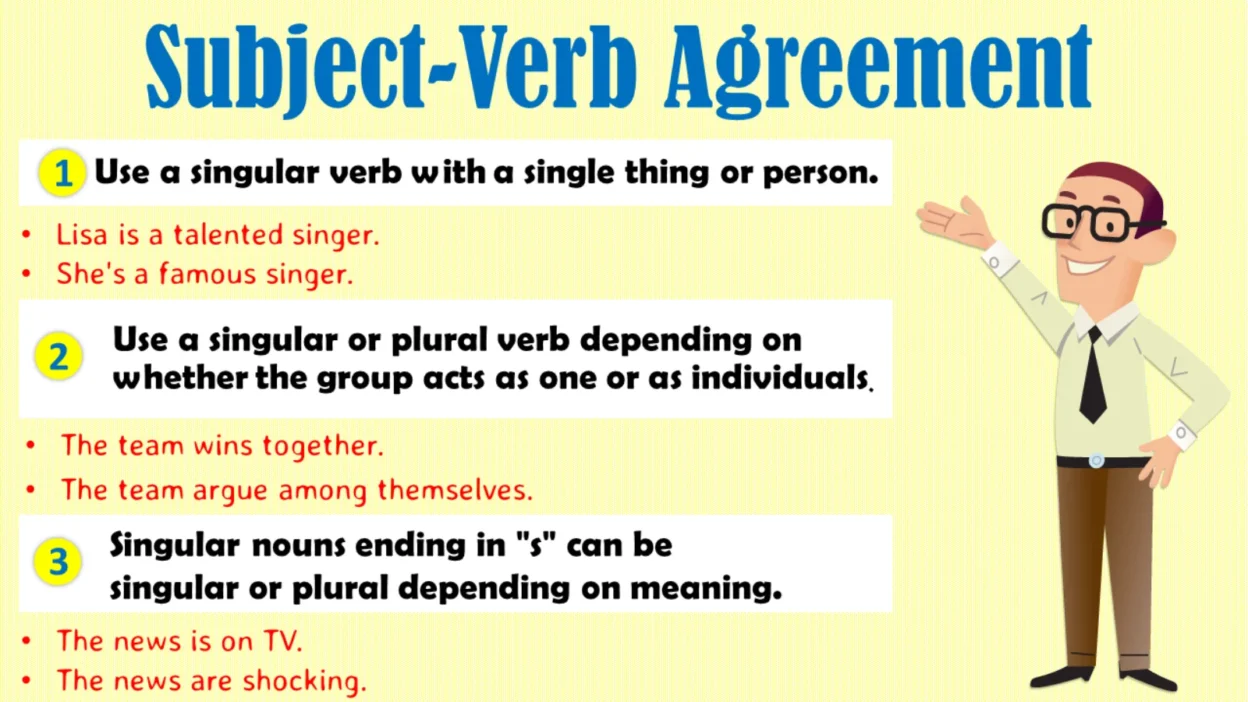
Rule 5: Use Singular or Plural Based on Meaning
- If the group acts as one unit → singular
- If members act individually → plural (more common in British English)
Examples:
- The team is winning.
- The team are arguing among themselves.
Subject Verb Agreement with Uncountable Nouns
Uncountable nouns are always singular.
Examples:
water, information, furniture, advice, money
Examples:
- The information is helpful.
- Furniture is expensive.
❌ Incorrect: The information are helpful.
Subject Verb Agreement with Numbers and Amounts
Rule 6: Time, Money, Distance = Singular
When talking about a single amount, use a singular verb.
Examples:
- Ten dollars is enough.
- Five years is a long time.
- Ten kilometers is far.
Subject Verb Agreement with Titles and Names
Titles of books, movies, songs, and organizations are singular.
Examples:
- “Harry Potter” is popular.
- The United Nations is meeting today.
Subject Verb Agreement with Relative Clauses
Words like who, that, and which take a verb based on the noun they refer to.
Examples:
- She is one of the students who work hard.
- He is the only student who works hard.
Common Subject Verb Agreement Mistakes
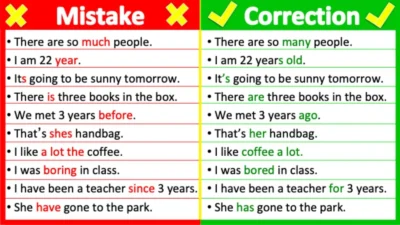
Mistake 1: Ignoring the Real Subject
❌ The list of items are on the table.
✅ The list of items is on the table.
(The real subject is list, not items.)
Mistake 2: Confusion with Prepositional Phrases
❌ A box of apples are missing.
✅ A box of apples is missing.
Mistake 3: Indefinite Pronoun Errors
❌ Everyone have their bag.
✅ Everyone has their bag.
Practice Sentences (Try Before Checking)
Choose the correct verb:
- Everyone ___ (know / knows) the answer.
- The dogs ___ (bark / barks) loudly.
- Either my parents or my brother ___ (is / are) coming.
- The team ___ (is / are) playing well today.
- Ten minutes ___ (is / are) enough.
Answers:
- knows
- bark
- is
- is
- is
Featured Snippet: Subject Verb Agreement Rules (Quick Explanation)
Subject verb agreement rules state that a singular subject takes a singular verb, while a plural subject takes a plural verb. The verb must always match the subject in number, not the object.
Frequently Asked Questions (FAQ)
What are subject verb agreement rules?
Subject verb agreement rules ensure that the verb matches the subject in number (singular or plural).
Why is subject verb agreement important?
It makes sentences grammatically correct and easy to understand in speaking and writing.
Is “everyone” singular or plural?
“Everyone” is singular and takes a singular verb.
How do I know which subject the verb agrees with?
Ignore prepositional phrases and focus on the main subject.
Are collective nouns singular or plural?
They can be both, depending on whether the group acts as one unit or as individuals.
Key Takeaways: Subject Verb Agreement Rules
- Singular subjects → singular verbs
- Plural subjects → plural verbs
- Ignore words between subject and verb
- Indefinite pronouns need special care
- Practice makes agreement automatic
Final Thoughts & Practice Tip
Subject verb agreement rules may feel confusing at first, but they become natural with practice. Read sentences aloud, notice patterns, and correct yourself gently.