
Sorry Generator
What Are Verbs in English?
Verbs in English are action words or state words. They tell us what someone does, feels, or is.
In simple words:
A verb shows an action, a state, or a happening.
Examples:
- She runs every morning.
- They are happy.
- The baby slept peacefully.
Without verbs, a sentence is not complete.
❌ She to school.
✅ She goes to school.
In this guide, you will learn:
- Types of verbs
- Verb forms
- Helping verbs
- Tenses
- Common mistakes
- Practice examples
This article is written in simple English so you can understand easily and improve step by step.
Types of Verbs in English
There are different types of verbs in English. Let’s understand them one by one.
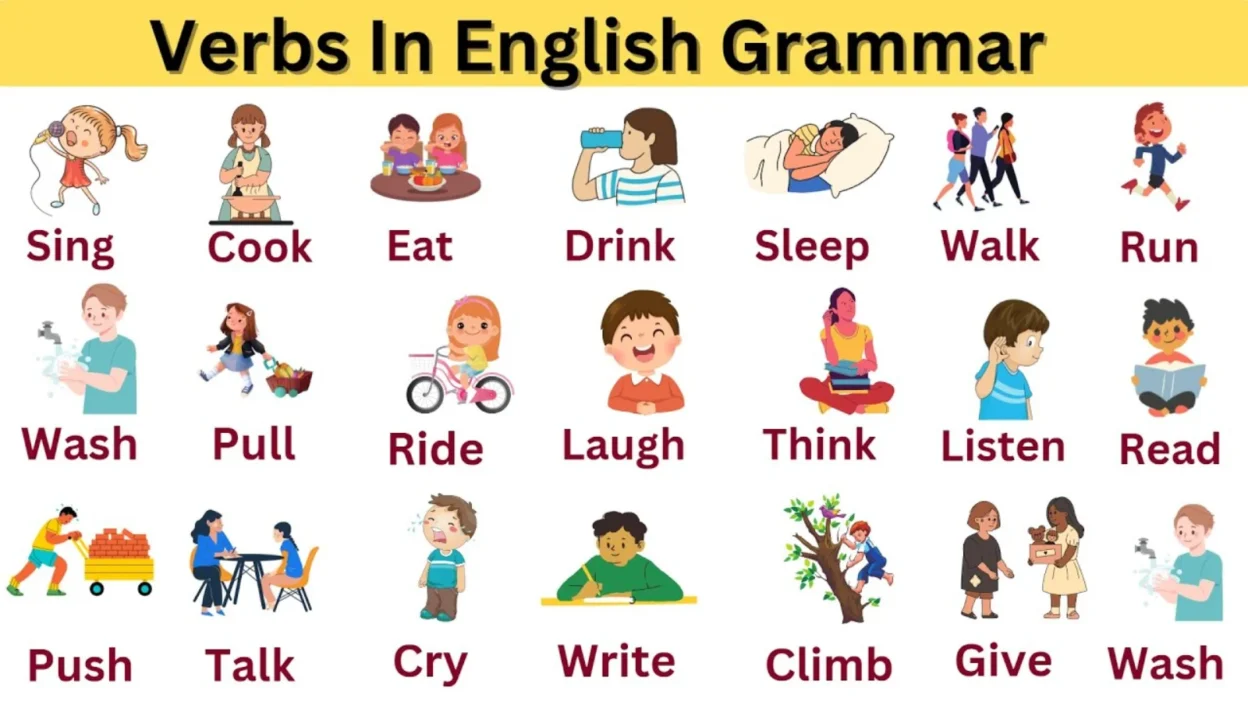
1. Action Verbs




Action verbs show physical or mental action.
Examples:
- run
- eat
- write
- think
- speak
- play
Sentences:
- I eat breakfast at 8 a.m.
- She writes a letter.
- They play cricket after school.
- He thinks about his future.
💡 Tip: If you can see or feel the action, it is usually an action verb.
2. Linking Verbs
Linking verbs connect the subject to more information.
Common linking verbs:
- am
- is
- are
- was
- were
- seem
- become
- feel
- look
Examples:
- She is a teacher.
- The sky looks blue.
- They were tired.
Linking verbs do not show action. They show a state or condition.
3. Helping Verbs (Auxiliary Verbs)
Helping verbs support the main verb.
Common helping verbs:
- is, am, are
- was, were
- have, has, had
- do, does, did
- will, shall
- can, could
- may, might
Examples:
- She is studying now.
- They have finished their work.
- I will call you tomorrow.
Helping verbs are very important in English tenses and questions.
4. Modal Verbs
Modal verbs show ability, permission, possibility, or advice.
Common modal verbs:
- can
- could
- may
- might
- must
- should
- will
- would
Examples:
- I can swim.
- You should study more.
- She might come today.
Modal verbs do not change form.
❌ She cans swim.
✅ She can swim.
Forms of Verbs in English (V1, V2, V3, V4, V5)
Every verb has different forms. These forms help us make different tenses.
| Base Form (V1) | Past (V2) | Past Participle (V3) | -ing Form (V4) | -s Form (V5) |
|---|---|---|---|---|
| go | went | gone | going | goes |
| eat | ate | eaten | eating | eats |
| play | played | played | playing | plays |
| write | wrote | written | writing | writes |
Example in sentences:
- I go to school.
- I went to school yesterday.
- I have gone home.
- She is going now.
- He goes daily.
Regular and Irregular Verbs
Regular Verbs
In the past form, regular verbs usually add -ed to the base verb.
Examples:
clean → cleaned
work → worked
play → played
Examples:
- work → worked
- play → played
- clean → cleaned
Sentence:
- She worked hard yesterday.
Irregular Verbs
Irregular verbs do not follow the -ed rule.
Examples:
- go → went
- eat → ate
- take → took
- see → saw
Sentence:
- He took my book.
💡 You must memorize irregular verbs. Practice daily.
Verbs and Tenses in English
Tenses show time. Verbs change according to time.
There are three main times:
- Present
- Past
- Future
Present Tense
Used for daily habits or facts.
Examples:
- I study English.
- She plays football.
- The sun rises in the east.
Past Tense
Used for finished actions.
Examples:
- I studied last night.
- She played yesterday.
- They went home early.
Future Tense
Used for future plans.
Examples:
- I will study tomorrow.
- She will call you.
- They will travel next week.
How to Use Verbs in Questions
We use helping verbs to make questions.
Examples:
- Do you like tea?
- Did she go home?
- Are they ready?
- Will you come tomorrow?
Structure:
Helping verb + subject + main verb
Example:
- Do + you + play football?
Verbs in Negative Sentences
We use “not” with helping verbs.
Examples:
- I do not like coffee.
- She is not ready.
- They will not come.
Short forms:
- don’t
- isn’t
- won’t
- didn’t
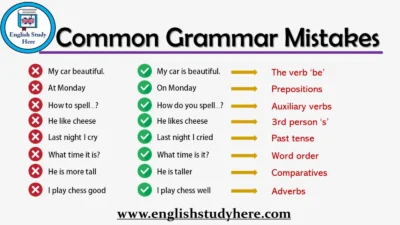
Common Mistakes with Verbs in English
Many learners make these mistakes:
1. Wrong Verb Form
❌ She go to school.
✅ She goes to school.
2. Using Two Past Forms
❌ Did you went there?
✅ Did you go there?
3. Missing Helping Verb
❌ She going home.
✅ She is going home.
4. Using Modal Incorrectly
❌ He can to swim.
✅ He can swim.
Real-Life Examples of Verbs in English
Daily routine example:
I wake up at 7 a.m.
I brush my teeth.
I eat breakfast.
I go to work.
I come home at 6 p.m.
Story example:
Yesterday, I visited my friend. We watched a movie and talked for hours. I enjoyed the day.
These simple sentences use verbs correctly and clearly.
Practice Section: Test Your Understanding
Fill in the blanks:
- She ___ (go) to market daily.
- They ___ (play) yesterday.
- I ___ (be) happy.
- He ___ (have) finished his work.
- We ___ (will / visit) Lahore next week.
Answers:
- goes
- played
- am
- has
- will visit
Featured Snippet: Quick Definition
What are verbs in English?
Verbs in English are words that show action, state, or occurrence. Every complete sentence needs a verb.
FAQ – People Also Ask
What are verbs in English?
Verbs are words that show action or state. Example: run, eat, is, have.
How many types of verbs are there?
Main types include:
- Action verbs
- Linking verbs
- Helping verbs
- Modal verbs
What is the difference between regular and irregular verbs?
Regular verbs add -ed in past tense (play → played).
Irregular verbs change differently (go → went).
Why are verbs important in English grammar?
Because every sentence needs a verb. Without a verb, the sentence is incomplete.
How can I improve my verbs in English?
- Practice daily
- Read simple English books
- Write small sentences
- Learn irregular verb lists
- Speak regularly
Schema-Ready FAQ (Short Answers)
Q: What is a verb?
A: A verb is a word that shows action or state.
Q: Do all sentences need a verb?
A: Yes, every complete sentence must have a verb.
Q: What is a helping verb?
A: A helping verb supports the main verb (is, have, will).
Q: What is a modal verb?
A: A modal verb shows ability or possibility (can, should, must).
Key Takeaways
- Verbs in English show action or state.
- Every sentence needs a verb.
- Learn verb forms (V1, V2, V3).
- Understand regular and irregular verbs.
- Practice tenses daily.
- Avoid common grammar mistakes.
Final Words
Learning verbs in English is the first big step to improving your grammar. Start with simple sentences. Practice every day. Make mistakes and learn from them.
If you want to improve faster:
- Write 5 sentences daily
- Speak in English with friends
- Review verb forms weekly